A pull request is a request for other developers or automation to review proposed changes before merging them into a target branch. In trunk-based development, developers work in feature branches and use pull requests to protect a releasable main branch. section 3.3 section 3.4.1
A pull request connects source changes to automated delivery controls:
- A service pipeline builds, tests, and validates the feature branch against the main branch before merging. section 3.4.1
- Merging into main triggers a service pipeline that creates a release and artifacts such as compiled code, container images, and Kubernetes manifests. section 4.3
- A service pipeline can create a pull request against an environment repository, allowing an environment pipeline to test or automatically merge low-risk changes. section 4.3
- Sensitive environments require additional checks and validations before their configuration changes are merged. section 4.3
Feature to environment
A developer finishes a Conference feature and opens a pull request against main. The service pipeline verifies that the change builds, tests, and can be released. After review and merge, another pipeline creates the service release and deployment artifacts, then opens a pull request updating a low-risk environment repository. That request is tested by the environment pipeline and may merge automatically. section 4.3 section 3.4.1
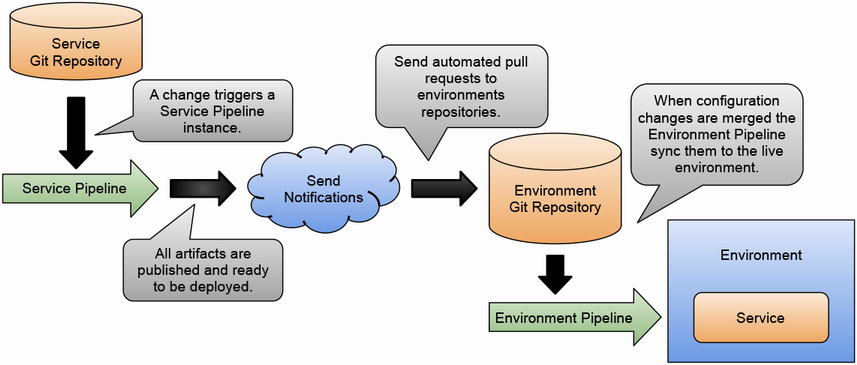
Trace how a pull request triggers service and environment pipelines across the promotion flow. section 4.3





