A Python class groups related data and functions into a reusable structure. The functions are methods; the data attached to each created object are attributes or instance variables. An object is an instance of a class, so different objects can share the same structure while holding different values. section 4.0 section 4.4
Classes help turn a growing collection of data-science steps into organized, portable code. Instead of repeatedly loading, splitting, and preparing a dataset in a notebook, a class can keep those operations and their resulting data together. This makes the code easier to integrate into a larger codebase or production workflow. section 4.0 section 4.2
Create and use a class in a few focused steps:
- Define it with the class keyword. Class names commonly start with an uppercase letter and use CamelCase, such as DataSet. section 4.2
- Put setup work in __init__. This constructor runs whenever a new object is created and commonly establishes instance variables. section 4.2
- Use self to refer to the current object, allowing methods to read or update data stored on that object. section 4.2
- Create an object by calling the class with its inputs, then use dot notation to access attributes or call methods. section 4.1.1 section 4.2
Encapsulating customer-churn preparation
A DataSet object can accept a feature list, file name, label column, and positive category. Its constructor reads customer-churn data, creates train and test splits, and stores the results on the object. Later, calling a method such as get_summary_plots() can produce feature distributions, while another method can evaluate prediction precision. The object keeps the related dataset state and operations in one place. section 4.2 section 4.2.1
Wrapping model tuning
A RandomForestModel class can store tuning settings such as a parameter grid, scoring metric, iteration count, and random state. Its tune method runs RandomizedSearchCV, and its predict method retrieves predictions. Generalizing the design into MlModel allows the same wrapper pattern to work with multiple scikit-learn model types. section 4.2.2 section 4.2.2
Figure 4.1 This diagram shows a commonly used class in Python’s core machine learning library (scikit-learn). This class represents a random forest classifier. We can create an object of this class, which corresponds to a specific random forest model. Like the random forest algorithm itself, we need to input parameters (number of trees, max depth, etc.). These parameters form the attributes of the random forest model object. Additionally, the object has methods for training and predicting.
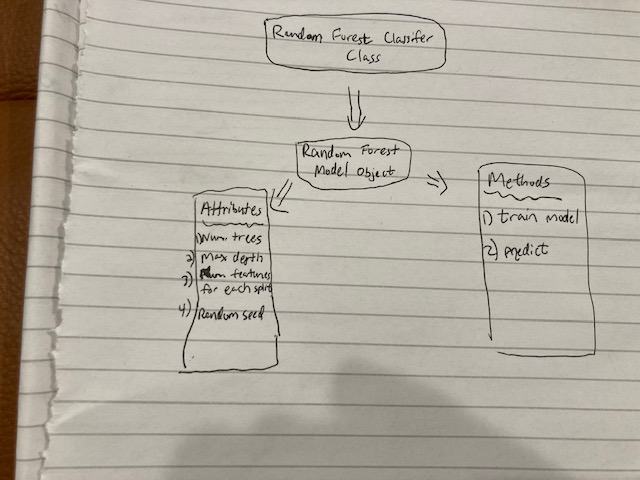
Inspect a random forest classifier as a class whose parameter values become object attributes and whose operations include training and prediction. section 4.1