Global interpreter lock
The global interpreter lock is a mutual-exclusion mechanism in CPython that permits only one thread at a time to execute Python bytecode within a process.

Refactoring to Rust
The Python Global Interpreter Lock is a synchronization mechanism in CPython that restricts execution of Python bytecode to one thread at a time within a process.
- How it is used
- Motivates moving a Python concurrency bottleneck into a Rust extension while preserving the surrounding Python application.
- How deep it goes
- Explains the lock’s safety and threading role, then demonstrates acquiring and releasing it through PyO3.
- Examples
- Uses a hall-pass analogy, a Python-versus-Rust JSON benchmark, and a Mandelbrot computation submitted to a thread pool.
- What you can do after
- Apply it via PyO3 to acquire the GIL for Python operations and release it around a Rust computation.
Read how Refactoring to Rust explains global interpreter lock →
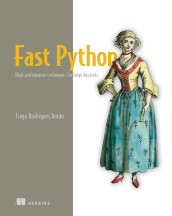
Fast Python: High performance techniques for large datasets
- How it is used
- Frames CPython threading limits when choosing concurrency and parallelism strategies for data processing.
- How deep it goes
- Explains execution limits and practical workarounds, without detailing the lock’s internal implementation.
- Examples
- Uses a futures-based MapReduce implementation and a Cython Game of Life simulation to illustrate concurrency and parallel alternatives.
- What you can do after
- Evaluate threading, multiprocessing, and GIL-releasing native code for a workload, accounting for communication overhead.
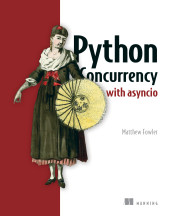
Python Concurrency with asyncio
- How it is used
- Guides the choice between threads, processes, and asyncio for CPU-bound and I/O-bound concurrency.
- How deep it goes
- Explains bytecode execution, reference counting, I/O release, and workload consequences, while deferring notable library exceptions.
- Examples
- Contrasts threaded Fibonacci calculations with synchronous and multithreaded HTTP status-code requests.
- What you can do after
- Evaluate whether threads, processes, or asyncio suit a workload and recognize when libraries may release the GIL.
Read how Python Concurrency with asyncio explains global interpreter lock →

Starting Data Analytics with Generative AI and Python
The Global Interpreter Lock is a Python runtime mechanism that restricts simultaneous execution of Python bytecode by multiple threads in one process.
- How it is used
- Guides decisions about whether multithreading will accelerate Python scaling workloads.
- How deep it goes
- Defines the memory-management role and performance limitation, but stops short of explaining interpreter internals.
- Examples
- Uses bootstrap confidence intervals, a 16-thread benchmark, and execution-time comparison figures.
- What you can do after
- Diagnose/debug with it by benchmarking threaded code and weighing GIL and parallelization overhead against workload size.
Read how Starting Data Analytics with Generative AI and Python explains global interpreter lock →
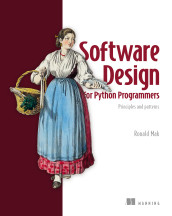
Software Design for Python Programmers
The global interpreter lock is a runtime lock in standard Python implementations that restricts execution of Python bytecode to one thread at a time within a process.
- How it is used
- Frames the GIL as a constraint that shapes Python multithreading and resource-synchronization choices.
- How deep it goes
- Defines concurrent versus parallel execution and stops short of detailed runtime internals.
- Examples
- Uses a shared frying pan, thread resource diagrams, and Lock-protected critical regions as concrete illustrations.
- What you can do after
- Evaluate whether threading or multiprocessing better fits concurrent versus parallel work.
Read how Software Design for Python Programmers explains global interpreter lock →
Also covered in
What to know first
- PythonPython is a high-level, general-purpose, dynamically typed programming language with readable syntax and support for multiple programming paradigms.
- I/OInput/output is the transfer of data between a program or system and external sources or destinations, such as files, devices, services, or networks.
- parallelismParallelism is the execution of multiple independent tasks or computational operations at the same time rather than sequentially.
- threadA thread is a distinct sequence of execution with its own control flow and state, managed or scheduled by a processor, runtime, or operating system.
Related concepts
- parallelismcontrasts with · Parallelism is the execution of multiple independent tasks or computational operations at the same time rather than sequentially.
- multiprocessingcontrasts with · Multiprocessing is a programming technique that executes work in multiple operating-system processes, enabling concurrent or parallel execution across available processor resources.
- multithreadingconfigures · Multithreading is the execution of multiple threads of control within a program, concurrently through interleaving or simultaneously.
- Pythonused by · Python is a high-level, general-purpose, dynamically typed programming language with readable syntax and support for multiple programming paradigms.
- asynciocontrasts with · asyncio is Python’s standard-library framework for asynchronous programming, built around coroutines, awaitable objects, and event loops.
- CPythonpart of · CPython is the reference implementation of the Python programming language, written primarily in C and providing its interpreter and runtime.
Questions about global interpreter lock
What is global interpreter lock?
The global interpreter lock is a mutual-exclusion mechanism in CPython that permits only one thread at a time to execute Python bytecode within a process.
Which Manning books explain global interpreter lock?
Refactoring to Rust, Fast Python: High performance techniques for large datasets, Python Concurrency with asyncio, Starting Data Analytics with Generative AI and Python and Software Design for Python Programmers.
What should I know before learning global interpreter lock?
Manning books that teach global interpreter lock usually introduce Python, I/O, parallelism and thread first.
What is the difference between global interpreter lock and parallelism?
The global interpreter lock is a mutual-exclusion mechanism in CPython that permits only one thread at a time to execute Python bytecode within a process. Parallelism is the execution of multiple independent tasks or computational operations at the same time rather than sequentially.
What is global interpreter lock part of?
Global interpreter lock is part of CPython. CPython is the reference implementation of the Python programming language, written primarily in C and providing its interpreter and runtime.
What is global interpreter lock also called?
Global interpreter lock is also called GIL.
These guides are generated from the text of Manning books by Manning's knowledge graph and link to the sections they draw on. The full books are available on liveBook and at manning.com.