PyTorch is an open-source, low-level deep learning framework for tensor computation and neural-network development. For tabular problems, it can support models that predict outcomes such as whether an Airbnb listing price exceeds the median. section 8.1
PyTorch is especially prominent in research, while TensorFlow is used more frequently in industry. Its design aims to remain accessible without requiring a separate high-level API, although additional toolkits can simplify development. section 8.1 section 8.7
Common ways to work with PyTorch for tabular deep learning include:
- Use PyTorch directly when retaining control over the framework's distinctive code and model-building details matters. section 8.2
- Use fastai for a general-purpose, high-level PyTorch API and tabular-data workflows designed to define, train, and exercise models with few lines of code. section 8.1 section 8.7
- Use Lightning when the main need is to abstract the training loop, or Lightning Flash for rapid prototyping, baselining, fine-tuning, and tabular problems. section 8.1 section 8.7
- Consider PyTorch Tabular or PyTorch-compatible TabNet when selecting a specialized tabular-data library. section 8.7
Figure 8.3 Deep learning stacks for tabular data
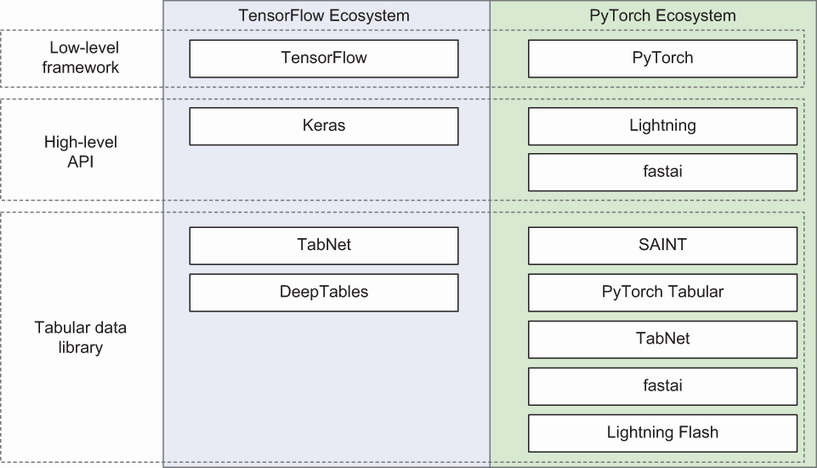
Compare the framework and high-level API layers available for deep learning with tabular data. section 8.1










