A quantum algorithm is a computational procedure designed for a quantum computer that exploits quantum-mechanical operations or information. Its value depends on matching a problem’s structure with a meaningful advantage over classical methods, not on accelerating arbitrary computation. section 1.10 section 1.2
Assess a candidate quantum algorithm by checking whether it has:
- A small input with substantial computational work, such as integer factorization or quantum-system simulation. section 1.2
- Exploitable structure, such as the periodicity used by Shor’s algorithm. section 1.2
- A sufficiently strong asymptotic improvement, since theoretical speedups may lose their appeal after implementation costs are included. section 1.2 section 1.3.1
Grover’s search
Given a black-box function with N possible inputs, Grover’s algorithm finds an input producing a target output in O(√N) function calls, compared with O(N) for the corresponding classical search. Its quadratic speedup may still be unattractive when classical methods exploit additional problem structure. section 1.3.1 section 1.2
Practical quantum algorithms connect mathematical reasoning to tested software. Qiskit supports circuit-level development through Python, while Q# emphasizes high-level algorithm design; both support development, testing, evaluation, and execution workflows. section 1.3.3 section 1.5
Figure 1.1 Quantum advantage might be achievable if the time a quantum computer takes to solve a certain problem grows at a slower rate as the problem size increases than the time a classical computer takes to do the same. In this case, problem instances that are much larger than the crossover size might be good candidates for quantum solutions. If the crossover time is months or more, quantum computing offers no practical advantage, since larger problem instances take much longer to solve, and running a quantum computer for months or years to solve a single problem is not practical.
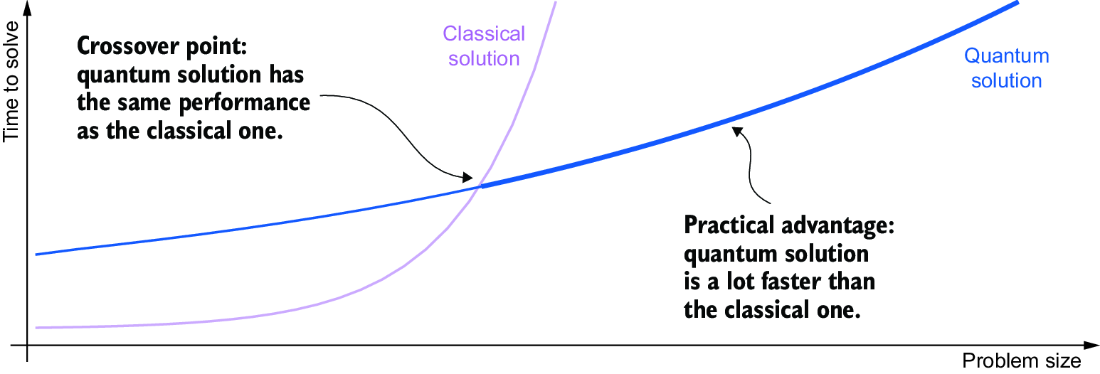
Compare quantum and classical runtime growth to locate possible crossover sizes and judge whether an apparent advantage is practically reachable. section 1.2

