A quantum superposition is a state written as a linear combination of computational-basis states. For one qubit, α|0⟩ + β|1⟩ uses amplitudes whose squared values sum to 1; |+⟩ = (|0⟩ + |1⟩)/√2 is the equal case. State preparation starts from |0⟩ and targets the required amplitudes rather than treating a fixed basis state as a useful general starting point. section 2.1 section 7.2.1
Linearity makes superposition programmable: apply a gate to every basis-state term and combine the results with the same amplitudes. Thus CNOT applied to α|10⟩ + β|01⟩ produces α|11⟩ + β|01⟩. Controlled rotations use the same rule when constructing larger states. section 2.3.1 section 2.1
Measurement in the computational basis returns one basis-state outcome. For real amplitudes, α|0⟩ + β|1⟩ yields 0 with probability α² and 1 with probability β²; for multiple qubits, each outcome probability is the square of its corresponding amplitude. A measurement therefore reads one component rather than the whole state. section 4.1.1 section 4.9
Figure 4.2 Measuring two qubits in a superposition of all basis states can give any of the results 00, 01, 10, and 11, with probabilities equal to squares of the amplitudes of the corresponding basis states in the superposition state. When we measure a system that is in a specific basis state, we can only get the result that corresponds to that state, with 100% probability.
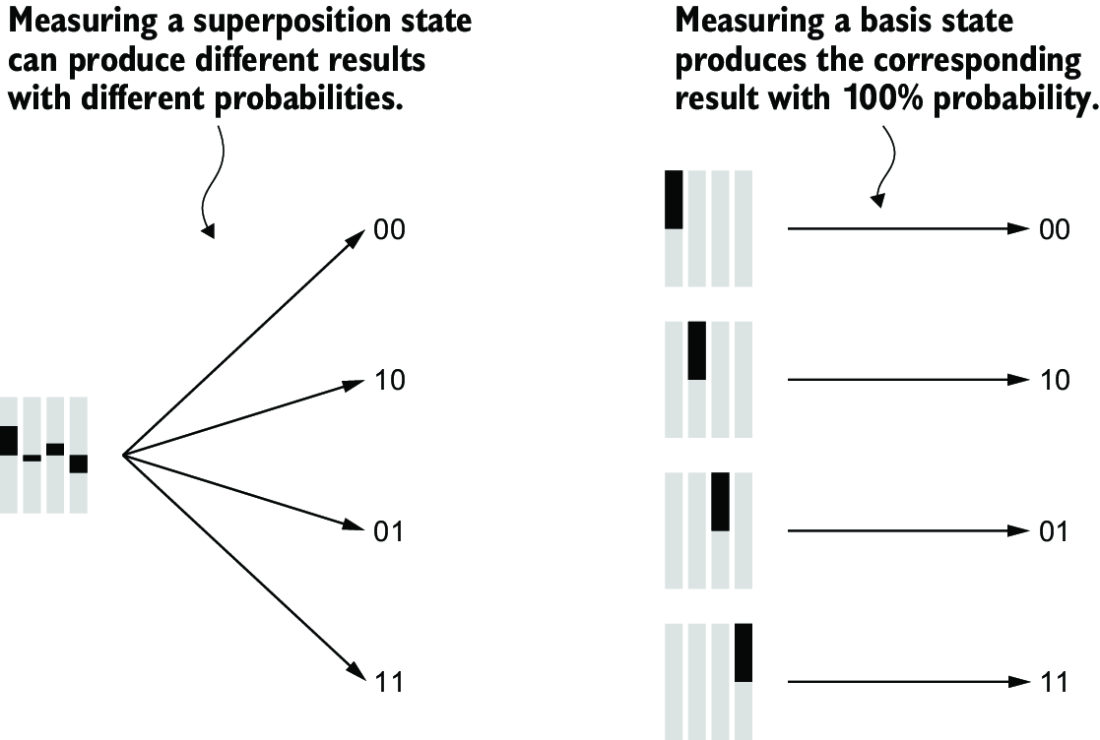
Compare a two-qubit superposition with a basis state: all basis states with nonzero amplitudes can occur, while a basis state has one certain outcome. section 4.1.1
Superposition serves several practical roles:
- Prepare an equal search-space state, assigning amplitude 1/√N to every candidate basis state before Grover-style search operations. section 7.2.1
- Turn a global phase into detectable relative phase by placing a control qubit in superposition before a controlled operation. section 5.1.1
- Evaluate classical functions across superposed inputs, while uncomputing auxiliary information that could remain entangled and disrupt interference. section 6.5.1
- Extract parity through a joint measurement when the state contains basis states of one parity, avoiding full collapse to a single basis state. section 4.6
Distinguishing overlapping superpositions
The orthogonal one-qubit states |+⟩ = (|0⟩ + |1⟩)/√2 and |−⟩ = (|0⟩ − |1⟩)/√2 both contain |0⟩ and |1⟩. A computational-basis outcome alone does not identify which was supplied, so distinguishing orthogonal superpositions with overlapping basis states requires an appropriate measurement procedure. section 4.3 section 4.9
Structured superpositions can be cheaper to prepare than arbitrary states. Useful extensions include states supported only on the first K basis states, on even- or odd-parity basis states, or on patterned nonzero amplitudes. General preparation may require complex amplitudes and rotations beyond Ry, including Rx and Rz. section 2.7


