A RabbitMQ queue buffers messages between microservices. Senders publish messages to a named queue, while receivers pull them when ready, avoiding a direct sender-to-receiver connection. section 5.6.2 section 5.8
This pull-based arrangement gives consumers control when they are overloaded or temporarily unable to process messages. A queue can also distribute each message to one recipient in a pool, so a job is handled once. section 5.8.2 section 5.8.6
A practical RabbitMQ queue workflow includes:
- Connect to RabbitMQ using AMQP and the amqplib library. section 5.8.2
- Assert the named queue, which checks for its existence and creates it only when necessary. section 5.8.6
- Publish a message by pushing it into the queue, or consume messages by pulling them from it. section 5.8.2
- Acknowledge a message after successful processing so an unacknowledged message can be handled again if a consumer fails. section 5.8.6 section 5.8.8
Viewed-message queue
A video-streaming service publishes a JSON message containing a video path to the viewed queue. The history service consumes it, parses the payload, records the view, and acknowledges the message. RabbitMQ treats the payload as binary data, so JSON serialization and parsing are handled by the application. section 5.8.6
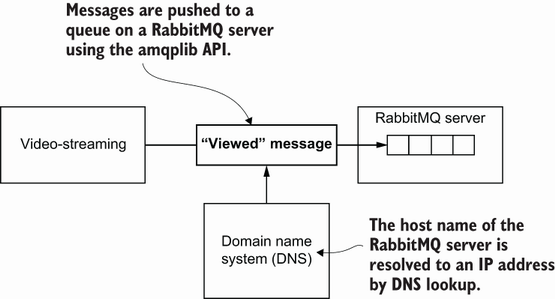
Shows the queue as the destination where a sender pushes an indirect message before a consumer retrieves it. section 5.8.2























