A radian measures an angle using a circle’s radius: one radian is the angle subtended by an arc whose length equals that radius. A full circle measures 2π radians. section 4.4.1 section 5.1.4
Use radians when building circular visualizations:
- Convert degrees with radians = degrees × π / 180. section 4.4.1
- Pass radian values to D3’s arc generator through startAngle() and endAngle(). section 4.5
- Calculate a pie or donut percentage as (endAngle − startAngle) / (2π). section 5.1.4
Convert precipitation data into an arc
If 126 of 365 days have precipitation, the share is about 35%, or 126 degrees. Convert it with 126 × π / 180 to obtain about 2.2 radians, then use that value as an arc angle. section 4.4.1
Figure 4.24 The dimensions of a Cartesian coordinate system are perpendicular to one another, while the polar coordinate system uses the radius and angle dimensions to describe a position in space.
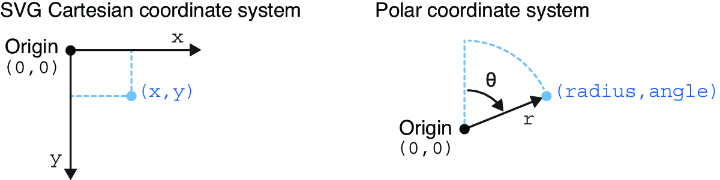
Compare polar coordinates, which describe positions with radius and angle, with Cartesian coordinates. section 4.4.1

