A random variable represents a quantity whose value comes from an uncertain outcome or probabilistic process. In multivariate modeling, several random variables are collected into a vector so their individual behavior and correlations can be modeled together. section 2.2.1
Within a multivariate Gaussian, each random variable has:
- An expected value given by the corresponding element of the mean vector. section 2.2.1
- A variance given by the corresponding diagonal entry of the covariance matrix. section 2.2.1
- Covariances with other variables represented by off-diagonal matrix entries. section 2.2.1
Everyday quantities
Height, IQ, income, and birth weight can be modeled as random variables; a housing-price example shows several such variables jointly through samples and confidence intervals. section 2.2.1
Figure 2.4 An MVN distribution groups multiple normally distributed random variables together. While the mean vector of the MVN concatenates the mean values, the covariance matrix models the correlations between the individual variables.
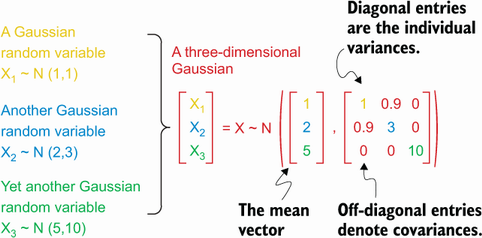
Visualizes how multiple normally distributed random variables form a multivariate Gaussian with a mean vector and covariance matrix. section 2.2.1




