A random vector is an ordered collection of random variables grouped into one vector. In multivariate Gaussian modeling, this grouping captures both each variable’s behavior and relationships between variables. section 2.2.1
For a Gaussian random vector X = [X₁, X₂, …, Xₙ] distributed as N(μ, Σ):
- The mean vector μ contains the expected value of each corresponding random variable. section 2.2.1
- The covariance matrix Σ contains individual variances on its diagonal and covariances between variables elsewhere. section 2.2.1
- Each component follows a normal distribution, while covariance describes how components vary together. section 2.2.1
Figure 2.4 An MVN distribution groups multiple normally distributed random variables together. While the mean vector of the MVN concatenates the mean values, the covariance matrix models the correlations between the individual variables.
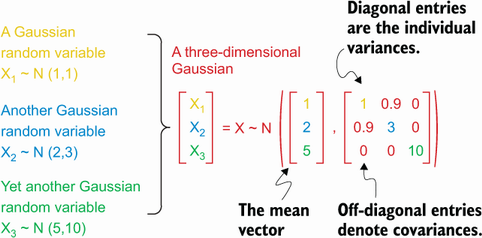
Use the diagram to see how multiple normally distributed variables combine into a mean vector and covariance matrix. section 2.2.1
