A random walk explores a graph by moving from a node to a connected neighbor, then repeating the move. Running many walks from each node produces sequences of visited nodes. Methods such as Node2Vec use those sequences to capture neighborhood context as node embeddings: vectors that can support visualization and machine-learning tasks. section 2.1 section 2.4.3
Proximity as a chance of encounter
Suppose node B cannot be reached from node A in one hop. Its one-hop encounter probability is zero. Under an example’s assumptions of equally likely directions and no repeated nodes, one of three possible two-hop routes reaches B, giving a two-hop probability of 1/3. This is one way to express graph proximity. Embedding walks need not use the no-repeats assumption: they may backtrack or visit a node again. section 2.4.1 section 2.4.3
Two embedding approaches choose walks differently:
- DeepWalk runs several fixed-size walks per node, treating connected neighbors as equally likely at each step. section 2.4.3
- Node2Vec biases walks with p, which controls returning to the previous node, and q, which steers exploration toward nearby or farther nodes. section 2.4.3
Figure 2.13 Depth-first search (DFS) and breadth first search (BFS) on a graph where embeddings are generated based on random walks using these graph-traversal strategies. DFS (light arrows) prioritizes going deep down one path, while BFS (dark arrows) prioritizes checking all adjacent and nearby paths.
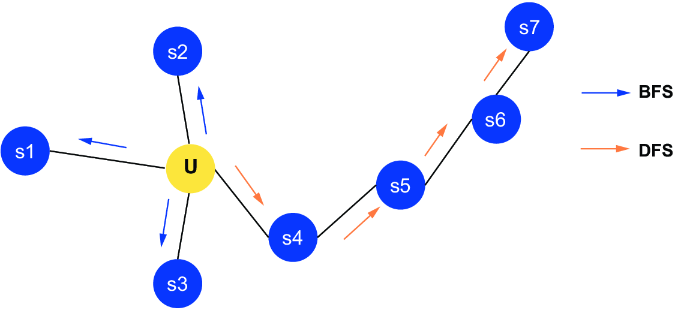
Compare breadth-first exploration of nearby paths with depth-first exploration along a path to see the neighborhood-versus-distance choice behind Node2Vec’s walk bias. section 2.4.3
In a graph of political books, nodes represent books and edges represent frequent co-purchases. A practical workflow sets walk length and walks per node in the Node2Vec Python library, generates embeddings, then projects them with UMAP for inspection. For supervised learning, align each embedding with its node label before training: independently generated walks do not guarantee that embedding order matches the graph’s node order. Node2Vec is suited to a fixed graph; its embeddings do not generalize to unseen data or graphs. section 2.1 section 2.3.1 section 2.5


