Randomization assigns units or intervention values through a random mechanism. In causal analysis, random assignment is a stochastic intervention: a platform digitally flips a coin to set the target variable. section 7.5.1
Randomization removes incoming causal influence from unknown common causes. It can therefore protect an experiment when the assumed causal DAG is incomplete, even though an ideal intervention may already identify the effect under a correct DAG. section 7.5.1 section 7.7
Implementation has two layers:
- Choose outcomes according to a specified distribution; computers emulate this process with deterministic pseudorandom number generators initialized by a random seed. section 2.2.2
- Assign experimental units to conditions independently of causes that might otherwise affect both treatment and outcome. section 7.5.1
Online gaming experiment
A digital experimentation platform randomly assigns players to high- or low-engagement groups, then compares in-game purchases. Assigning the first players to one group and later players to another could fail if login time affects both engagement and purchases. section 7.5.1
Figure 7.12 Randomization eliminates incoming edges from unknown common causes.
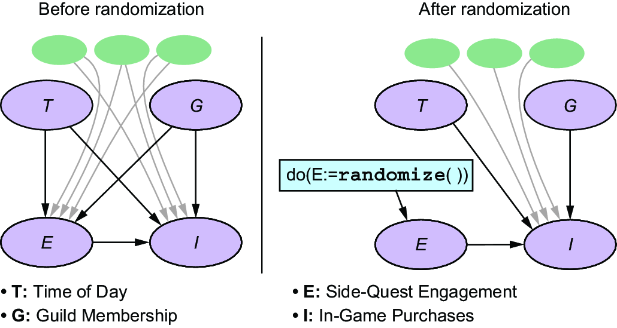
Diagram showing how randomization eliminates incoming edges from unknown common causes. section 7.5.1




