Randomization assigns participants or units to experimental groups or treatment conditions by chance. In an A/B test or randomized controlled trial, this makes the groups comparable on average when the sample is sufficiently large, so differences in outcomes can estimate a causal effect rather than merely describe an association. section 1.3.4
Comparing treatments
Suppose one group receives an old treatment and another receives a new treatment. If 80% of the new-treatment group improves and 70% of the old-treatment group improves, the difference in group averages is the average treatment effect (ATE). Random assignment supports interpreting this difference as the effect of the treatment, provided execution is careful. section 1.3.4
Randomization can also serve as an instrumental variable when treatment uptake is imperfect. In a noncompliant clinical trial, patients may choose whether to take the assigned treatment, so their characteristics can confound comparisons between treated and untreated patients. Group randomization remains independent of those choices and can support instrumental-variable estimation. section 9.1.3
Figure 9.2 Instrumental variables diagram. The variable Randomization plays the role of an instrument, and the set of confounders Customer Context is unobserved.
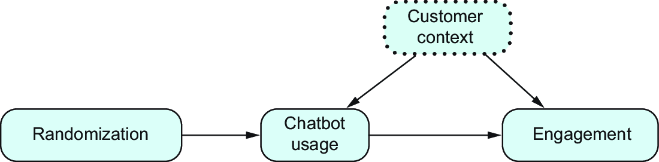
The diagram traces Randomization into experimental groups, distinguishes assignment from chatbot usage, and shows how unobserved customer context confounds usage and engagement. section 9.1.1




