Range is the interval of values a numerical representation can encode. With a fixed bit width, expanding that interval leaves fewer representable steps within it; narrowing the interval allows finer resolution. Quantization therefore requires choosing which values matter. section 1.3.2 section 2.1
For fixed-width integer representations:
- An 8-bit signed integer has 256 possible values, from −128 to +127; values outside the chosen range cannot be represented. section 1.3.2
- In Q3.4, the scale is 1/16, so the signed 8-bit range is −8 to 7.9375, with steps of 0.0625. section 2.1
- For an 8-bit container, allocating more bits to the integer part doubles the range while halving precision. section 2.1
Q3.4 saturation
The value 10.0 exceeds the signed Q3.4 maximum of 7.9375, so it is stored as 7.9375. The fixed range prevents the original value from being represented. section 2.1
Figure 1.3 Floating point concentrates precision near zero (top), leaving large values sparsely represented. Integers use uniform spacing across your chosen range (bottom). Quantization is the act of deciding where to place that fixed grid.
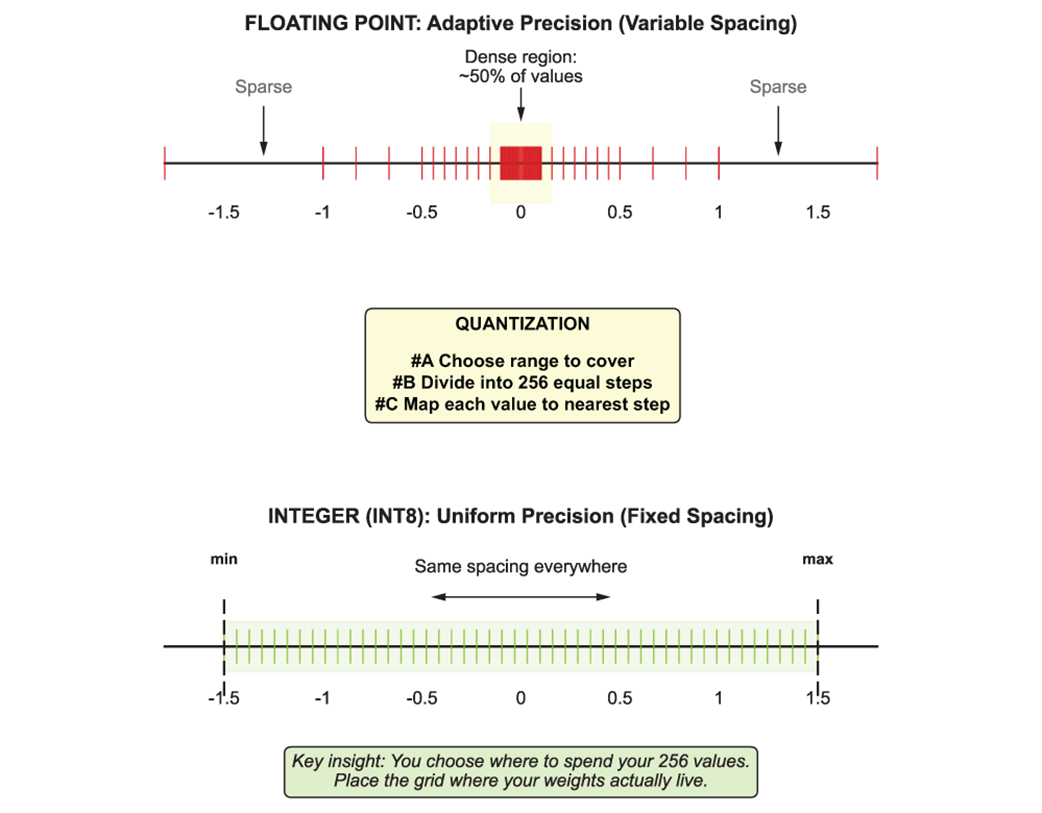
Compare floating-point spacing, concentrated near zero, with the uniform grid used by integers across a chosen range. section 1.3.2

