A Git repository stores project source code and its revision history, then connects developer changes to automated build, packaging, deployment, and environment-management workflows. section 3.4.2 section 4.2
A repository supports several operational responsibilities:
- Triggers service pipelines through webhooks when changes are merged into the main branch. section 3.4.2
- Carries the files needed to build and deploy a service, including source code, a Dockerfile or image-building method, and Kubernetes manifests. section 3.4.2
- Organizes services either together in one repository or separately, affecting webhook filtering, pipeline definitions, access management, and reuse. section 3.6
- Acts as the source of truth for environment configurations that declare deployed services and their versions. section 4.1
Service and environment repositories
A service repository can contain a src directory, Dockerfile, and Kubernetes deployment configuration. After a release is published, an environment repository can be updated to point staging or production at the released service version. Argo CD can monitor that configuration and synchronize it with a live cluster. section 3.4.2 section 4.1 section 4.2
Figure 3.6 The service source code repository needs to have all the configurations for the service pipeline to work.
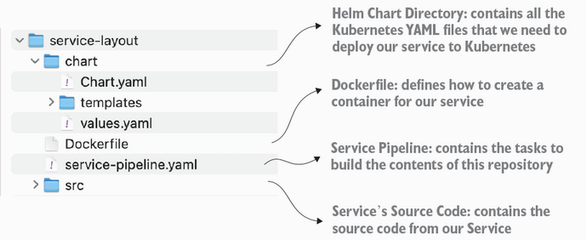
Use the repository layout to inspect how service source, container-building configuration, and deployment configuration give a pipeline the inputs it needs. section 3.4.2









