liveBook · Manning

Output layer

As explained in Data Without Labels

An output layer is the final neural-network layer that transforms preceding activations into a prediction or other task output.

An output layer is the final decision layer of a neural network. It receives activations from preceding hidden layers and produces a prediction for the task. section 8.2.3

Its role depends on how the network expresses the task output:

  • Passes information forward after hidden layers process inputs through weights, biases, and activation functions. section 8.3.2
  • Makes the task prediction, such as identifying an object or classifying an image. section 8.2.3
  • Uses softmax for classification when the output should provide probabilities for different classes. section 8.6.1

Face and image classification

A face-identification network can produce the probability that an image belongs to Mr. X. In a cat-versus-dog classifier, a softmax output gives the probability for each class. section 8.3.2 section 8.6.1

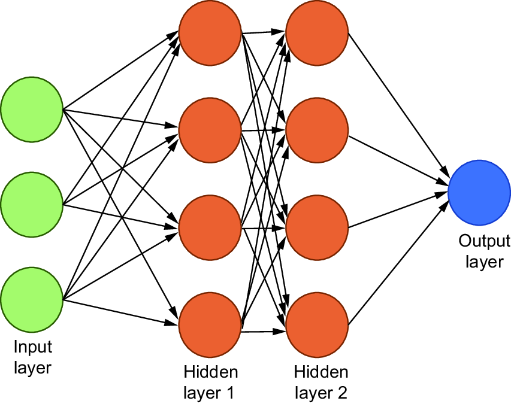
Figure 8.4 A typical neural network with neurons and input, hidden, and output layers
figure

Use the network diagram to trace data from the input layer through hidden layers to the final output layer. section 8.2.3


How Data Without Labels covers it

How deep it goes
Explains position, forward information flow, and softmax probabilities, but does not detail output-layer internals.
Examples
Uses face identification, object recognition, image classification, and cat-versus-dog probability outputs as examples.
What it assumes
Assumes familiarity with neural-network inputs, hidden layers, weights, biases, and activation functions.
What you can do after
Evaluate/understand predictions as task outputs and interpret classification results as class probabilities.
How it connects
Connects the output layer to input layers, hidden layers, feed-forward propagation, activation functions, and softmax.

Also explained in

Compare how 6 books explain output layer →

Related concepts

This explainer was generated by Manning's knowledge graph from the text of Data Without Labels. The section links point to the parts of the book it draws on.



