The output layer is the final neural-network layer: its units turn hidden-layer activations into the result returned by the network. A layer’s activation function should fit the problem; for example, sigmoid values can represent probabilities, while a step function can produce a clear 0 or 1 decision. section 9.16 section 9.4
Forward propagation reaches the output layer in a short sequence:
- Multiply inputs by weights and sum them for each hidden node. section 9.4
- Apply the hidden-layer activation function, producing activation intensities. section 9.4
- Combine hidden activations with the weights leading to the output node, then apply the output activation. section 9.4
Predicting collision risk
For a car-collision network, scaled inputs such as speed, terrain quality, degree of vision, and total experience pass through the hidden layer. The output node then produces the estimated chance of a collision. A compact implementation stores hidden-to-output weights and computes the result with sigmoid(np.dot(hidden, weights_hidden)). section 9.4
Figure 9.19 Final activation calculation for the output node
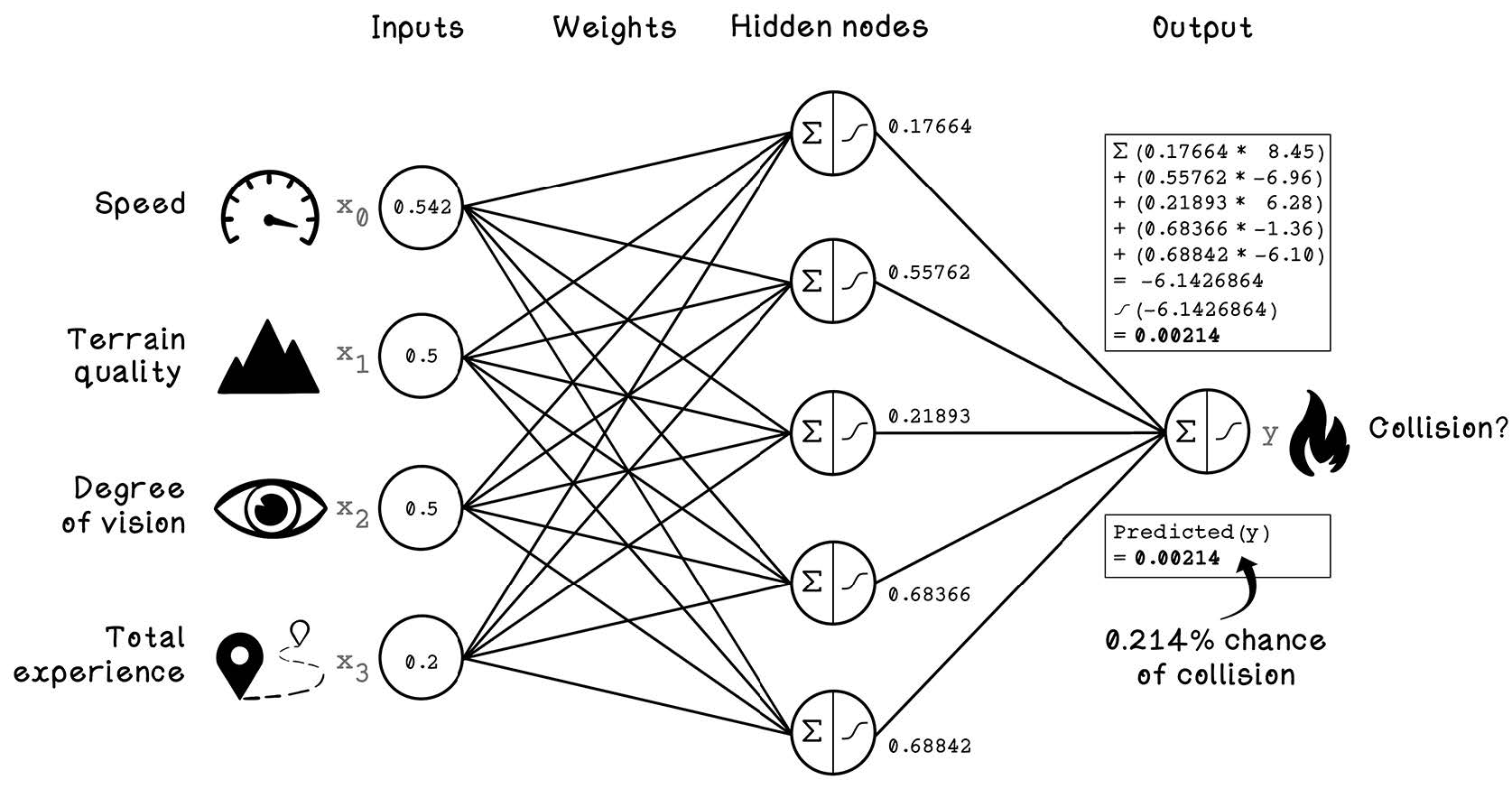
Trace the final activation calculation that converts hidden-node activations into the output value. section 9.4





