Decoding turns an LLM’s internal numerical representations toward human-readable language. Encoding first translates text into token IDs; after self-attention processes relationships among those tokens, decoding makes it possible to predict and generate text. section 11.4
A simple way to follow the path is:
- Start with tokens represented as numbers and embeddings. section 11.11
- Use self-attention to process how tokens relate to one another. section 11.11
- Use the decoder to produce a probability distribution for the next token, supporting text generation. section 11.11
A small language-model example
Imagine training on a single paragraph. Its text becomes token IDs, the model processes their relationships, and decoding produces next-token predictions. This small setup helps trace the steps, but one paragraph is not enough to make the model notably capable. section 11.4 section 11.11
“Decoder” also names a different component in a U-Net for images. There, an upsample path reconstructs a full-resolution image from a compressed representation, with skip connections supplying lost spatial detail. That is not text decoding. section 12.15
Figure 11.24 A simplistic overview of the Transformer framework
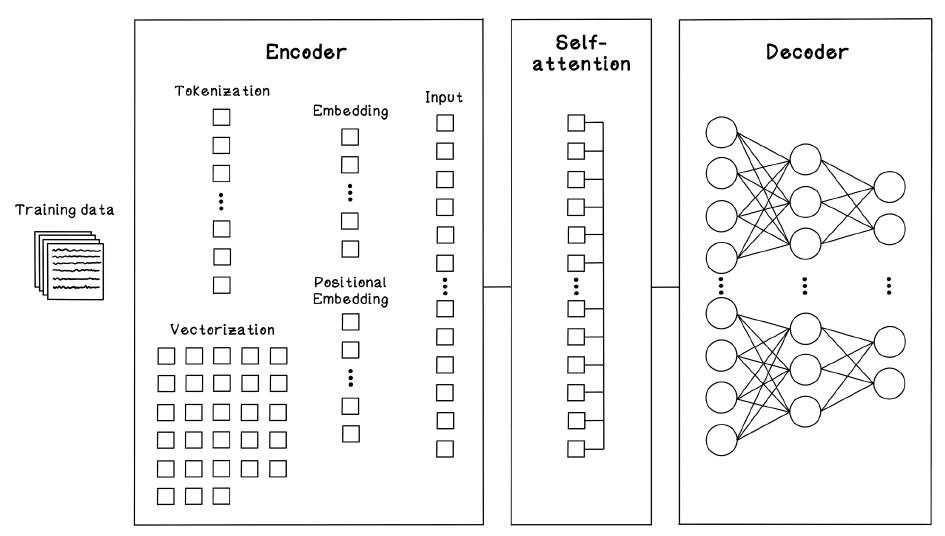
Use the Transformer overview to locate the decoder after embeddings and self-attention. section 11.11














