A decoder generates an output sequence one step at a time. In a pointer network, it is a recurrent neural network that uses its previous output and hidden state while attention selects from the encoded input. This is useful when an answer is an ordered selection of input elements, as in a convex hull. section 11.3.3
For each output step:
- The encoder has produced a hidden state for each input element; the decoder updates its state using the previous output. section 11.3.3
- Attention scores the input states against the decoder state. Softmax turns those scores into a probability distribution over input positions. section 11.3.3
- The resulting pointer identifies the next input element in the output sequence. A context vector from attention also informs the decoder’s prediction. section 11.3.3
Selecting convex-hull points
Given points indexed [1, 2, 3, 4], a pointer network can output [1, 4, 2]: the ordered hull vertices. Point 3 lies inside that hull, so it need not appear in the output. For a larger experiment, train ConvexNet on random 2D point sets, then compare predicted hull indices with SciPy’s ConvexHull vertices. Test across point-set sizes rather than relying on one plotted result: reported accuracy and hull overlap vary with size. section 11.3.3 section 11.9
Figure 11.19 Solving the convex hull problem using Ptr-Net. The output in each step is a pointer to the input that maximizes the probability distribution.
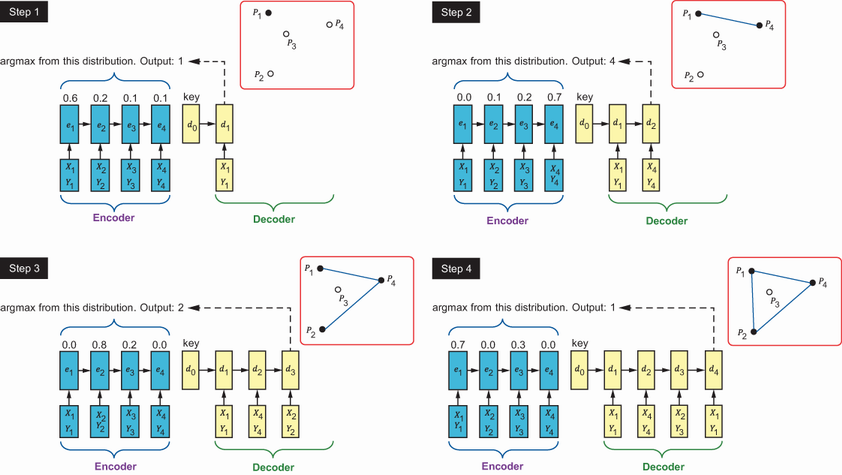
The figure shows the key decoding decision: at each step, the output points to an input position with the highest probability. section 11.9
A decoder need not always produce pointers. In graph embedding, an encoder compresses graph structure into a low-dimensional representation, and a decoder can extract specified information from that representation. Jointly optimizing both components shapes what the embedding retains. section 11.3.1














