liveBook · Manning

Critical thinking

As explained in Introduction to Generative AI, Second Edition

Critical thinking is the deliberate evaluation of information, reasoning, evidence, and conclusions before accepting or acting on them.

Critical thinking is the deliberate evaluation of information, reasoning, evidence, and conclusions before accepting or acting on them. With generative AI, it means treating an output as a draft to inspect rather than an authority to trust. section 6.8

Applied to AI-assisted learning, critical thinking involves:

  • Checking generated responses for accuracy, bias, limitations, and privacy concerns. section 6.8
  • Critiquing and revising first drafts instead of submitting them unchanged. section 6.8
  • Using debate, peer review, and writing support to examine claims and improve reasoning. section 6.8
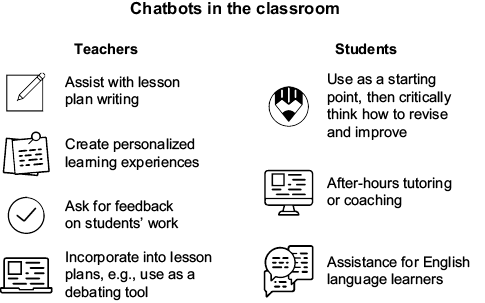
Figure 6.8 Examples of how educators and students can integrate generative AI tools in the classroom
A screenshot of a black and white screen

AI-generated content may be incorrect.

Examples of classroom activities show how generative AI can become an object of critique as well as a productivity tool. section 6.8


How Introduction to Generative AI, Second Edition covers it

How deep it goes
Demonstrates classroom practices for evaluating AI responses, revising drafts, and discussing limitations.
Examples
Uses ChatGPT drafts, accuracy reviews, debates, peer review, and English-language writing support.
What it assumes
Assumes only the ability to review claims and outputs, while teaching skepticism through concrete AI examples.
What you can do after
Practice evaluating, critiquing, and revising generative AI responses before relying on them.
How it connects
Connects critical thinking with generative AI, bias, privacy, debate, peer review, and writing support.

Also explained in

Compare how 3 books explain critical thinking →

Related concepts

This explainer was generated by Manning's knowledge graph from the text of Introduction to Generative AI, Second Edition. The section links point to the parts of the book it draws on.
