A data stream, or event stream, is a continuous flow of independent records produced by people or machines. Each record represents something that happened, such as a purchase, link click, sensor transmission, or package handoff. section 1.1 section 1.2
Treat each event as a record with three conceptual parts:
- Key — identifies the event and can support routing or grouping, such as a customer ID. section 1.2
- Value — carries the event payload, such as a purchased item or sensor trigger. section 1.2
- Timestamp — records when the event occurred. section 1.2
Read a stream as an ordered sequence of independent occurrences, not as successive updates to one object. Even records with the same key remain separate events; viewed as a database, each record resembles an insert into a table. section 8.1
Tracking a delivered package
One purchase generates a sequence of events: the initial order, each custody transfer, arrival at a distribution center, loading for delivery, and final handoff. Each action contributes a timestamped record to the stream. section 1.3
Table 1.1 Definitions
|
Event
|
Something that occurs and attributes about it recorded
|
|
Event Stream
|
A series of events captured in real-time from sources such as mobile or IoT devices
|
|
Event Streaming Platform
|
Software to handle event streams—capable of producing, consuming, processing, and storage of event streams
|
|
Apache Kafka
|
The premier event streaming platform—provides all the components of an event streaming platform in one battle-tested solution
|
|
Kafka Streams
|
The native event stream processing library for Kafka
|
Use the definitions table to distinguish events, event streams, event-streaming platforms, Apache Kafka, and Kafka Streams. section 1.2
Figure 1.1 A sequence of events comprising an event stream starting with the online purchase of the flux capacitor
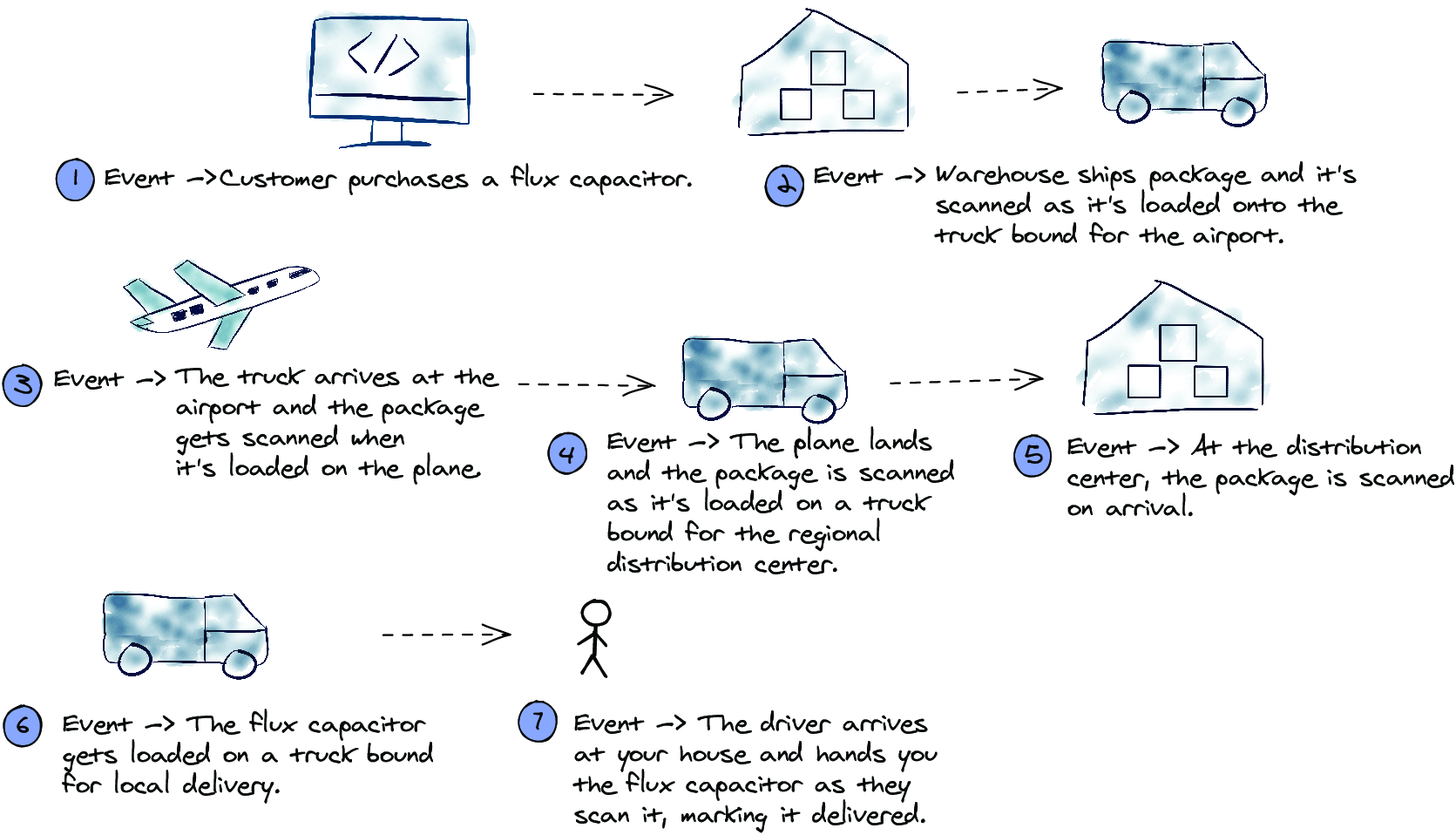
Follow the package timeline as a visual model of independent events accumulating into one unbounded stream. section 1.3


