A reasoning model is a language model trained to perform intermediate work before producing an answer. Rather than relying only on a prompt to request step-by-step reasoning, it integrates that behavior into training and inference-time computation. This can give the model more opportunity to decompose a problem, check partial results, and revise its approach. section 9.2.2
The intermediate work is not necessarily visible. A response may contain a brief explanation even when the model has generated, evaluated, or revised more material internally. A visible chain of thought can help solve a problem or explain an answer, but it can also be a misleading trace of how the answer was reached. section 9.2.2 section 9.2.3
Training can combine supervised examples of useful intermediate steps with reward-based training that favors correct answers and reliable reasoning behavior. How intermediate reasoning improves performance is not settled: proposed explanations include giving later steps more context, guiding generation toward promising continuations, and making partial errors easier to correct. section 9.2.2 section 9.2.3
Controlled puzzle tests
A 2025 study tested models on puzzles including Tower of Hanoi and River Crossing, asking for valid sequences of moves as complexity increased. It reported an advantage for reasoning models at intermediate complexity, but a sharp decline for both reasoning and ordinary language models at high complexity. The results caution against treating success on some multi-step tasks as proof of stable performance at greater scale. section 9.4.1
Figure 9.8 Three performance regimes reported in “The Illusion of Thinking.” Standard language models perform well at low complexity, while reasoning models gain an advantage at intermediate complexity. At high complexity, both decline sharply, and reasoning models may reduce their reasoning effort even when additional token budget remains available.
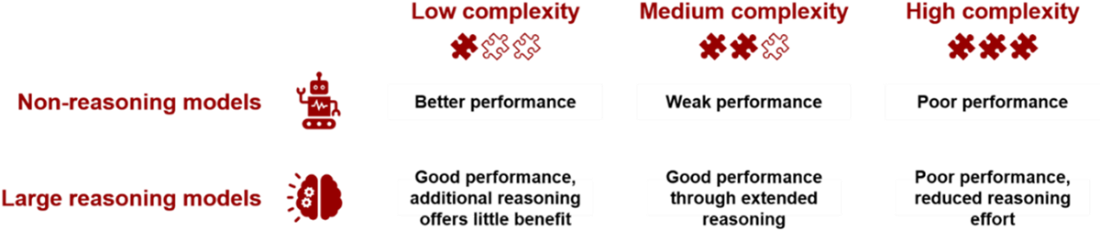
The figure contrasts the reported performance regimes as puzzle complexity increases. section 9.4.1
These results make evaluation important but not straightforward. A failure may reflect limits in reasoning, execution, the interface, or the benchmark itself. Observable performance and a fluent explanation do not by themselves establish the underlying mechanism. section 9.2.3 section 9.6






