A recurrent neural network (RNN) predicts from a sequence by carrying information from one timestep to the next. It is useful when the recent past matters: given several frames of body-joint sensor positions, an RNN can predict where those sensors will move. This provides a temporal baseline without using the connections between joints. section 6.2.2 section 6.4
Think of the network as the same update repeated across time:
- Start with an initial hidden state. At timestep t, combine the new input with the preceding hidden state to produce an updated state and output. section 6.5.1
- Carry that state into the next timestep alongside the next input. An unfolded view shows these updates as a chain rather than a single recurrent self-loop. section 6.5.1
- Train by backpropagating through time. For future-position prediction, compare outputs with target positions, then use predictions to continue a forecast. section 6.5.1 section 6.2.2
Figure 6.17 Structure for an RNN. Temporal updates as a single self-loop denoted by Whh (left). An unfolded model in time showing the model updates (right). Here, we change our input, output, and hidden layers (x, y, h) to be temporal variables (xt, yt, ht). At our initial step, t, we update our current hidden layer with input data from xt and the weights from our previous hidden layer ht–1 and then use this to output yt. The weights from ht are then passed to ht+1 along with the new input at xt+1 to infer yt+1.
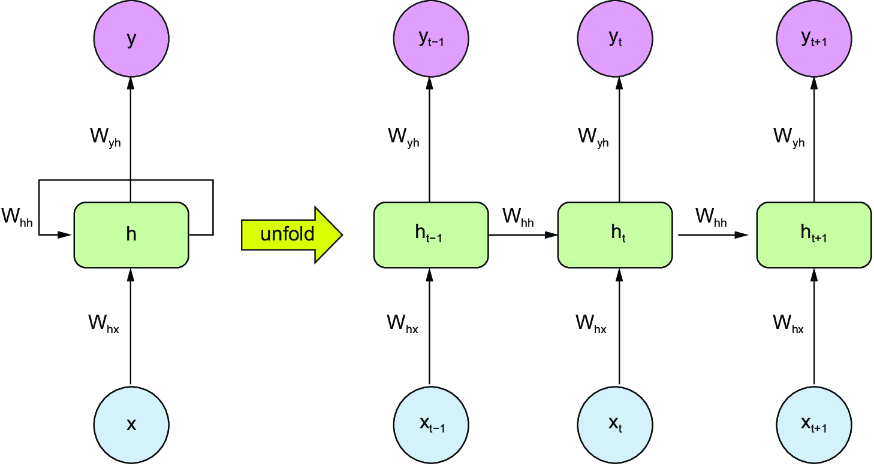
The self-loop and unfolded views show how input and hidden state contribute to successive outputs. section 6.5.1
Pose prediction with PyTorch
Define an nn.RNN with input size, hidden size, layer count, and batch_first=True. Initialize its hidden state for the batch, run the input sequence through the RNN, and pass selected outputs through a linear layer to predict sensor positions. A training loop computes loss, backpropagates, and updates the model; a testing loop generates future predictions. section 6.5.1 section 6.2.2
A basic RNN has limited short-term memory; LSTMs and gated recurrent units (GRUs) are recurrent alternatives for more demanding sequences. An RNN trained only on sensor positions also misses the relationships between sensors. Neural relational inference addresses both kinds of information by combining graph-derived representations with a recurrent decoder. section 6.2.2 section 6.4 section 6.5.3









