Reference-free evaluation assesses an AI output’s quality without comparing it with a gold-standard answer. It is useful for open-ended tasks, where several responses may be valid and quality depends on context. By contrast, reference-based evaluation compares an output with a human-created or verified answer. section 1.1 section 1.1.2
A reference-free workflow starts with the task’s quality criteria:
- Define quality signals for the task, potentially guided by expert criteria. section 1.1.2 section 1.5
- Generate outputs for test inputs and assess their intrinsic properties without reference answers. section 1.1.2
- Inspect the resulting scores for quality patterns and failure modes. section 1.1.2
Quality depends on the audience
For “Explain machine learning,” an analogy about learning from examples may suit a third-grader. An answer for a software engineer should instead address topics such as data pipelines, training, and validation. A reference-free evaluation must judge the response against the needs of its intended audience rather than assume one answer fits both. section 1.1.2
A score is not a universal measure of quality: the criteria must fit the task, and people can disagree about open-ended responses. Fluent wording also does not guarantee factual grounding; faithfulness metrics can help measure hallucinations. section 1.1.2 section 1.5
Figure 1.5 Reference-free evaluation workflow. Quality signals are defined for the task. The AI generates outputs for test inputs. Metrics assess each output’s intrinsic properties without reference answers. Scores reveal quality patterns and failure modes.
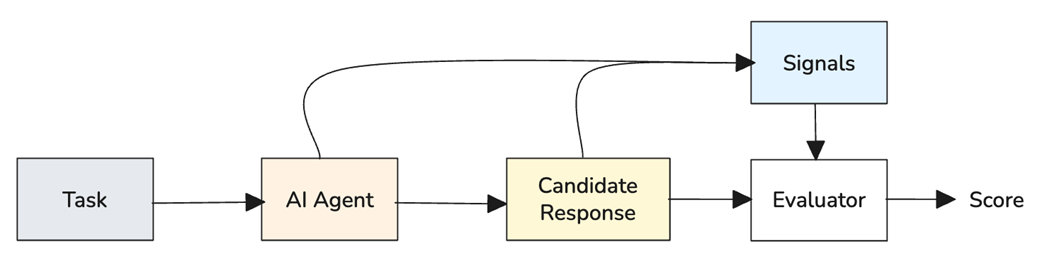
Trace the workflow from task-specific quality signals to scores and failure patterns. section 1.1.2



