Refine retries a DSPy program, scoring each response with a reward function and using feedback to improve later attempts. It stops when a score exceeds a threshold or it reaches the iteration limit, then returns the best-scoring response. section 7.3.4
A typical Refine run:
- Wrap a DSPy program with Refine and provide a reward function, maximum iteration count N, and score threshold. section 7.3.4
- Score each response; if it misses the threshold, use model feedback as a hint for the next attempt. section 7.3.4
- Expect two model calls per iteration: one for the program response and one to generate feedback when continuing. section 7.3.4
Enforcing a one-word answer
For a question about Belgium’s economic capital, a reward function can return 1.0 for a one-word answer and 0.0 otherwise. Refine is configured to try up to three times and stop at a score of 1.0. section 7.3.4
Figure 7.1 The workflow within the Refine module starts with the original prompt, which is used in a call to the LM. The response is collected, and Refine calls the reward method to evaluate it. At each iteration, the LM is also called to get feedback about the prompt and the response, including advice on how to improve the prompt. When asking for this advice, Refine also provides the LM with task and reward function information, a history of the previous prompts, and the reward function’s scores for their outputs. This advice is used as the hint field in the next call to the LM. Once the response is good enough (the reward function gives it a score above a specified threshold) or the process loops a specified number of times, the best response (as evaluated by the reward function) is returned.
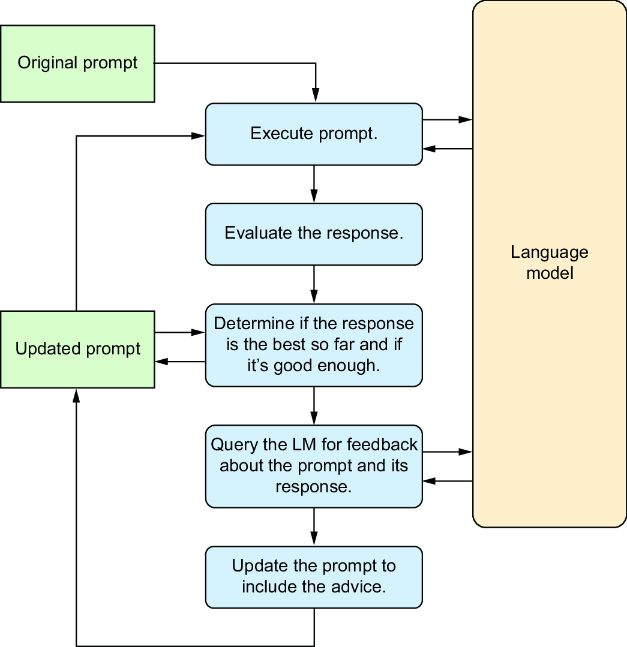
Follow the response-scoring and feedback loop, including how reward scores and prompt history inform later attempts. section 7.3.4
