Regularization discourages solutions that memorize training examples, aiming to preserve generalization. The classical account says training error falls as model capacity grows, while test error eventually rises; regularization limits capacity or improves robustness, favoring the bottom of the bias–variance curve. section 8.5.2
AlexNet and overfitting
AlexNet’s 60 million parameters raised concerns about overfitting. Its authors used data augmentation, dropout, and weight decay. Dropout randomly disables neurons during training; AlexNet dropped half the neurons in its first two fully connected layers. section 8.5.2 section 2.5.2
Modern overparameterized networks complicate the classical picture: test error can fall again beyond the interpolation threshold. Explicit regularizers and an optimizer’s implicit biases can steer models that fit every training example toward simpler functions. In grokking, sufficient regularization accompanies a rise and then a fall in internal complexity as the network shifts from memorization to generalization. section 8.5.2 section 8.5
Figure 8.9 Left: the classical bias–variance tradeoff. Training error (called “risk” in this image) is shown as a dashed line. It falls monotonically, whereas the test error (solid line) is U-shaped, with the bottom being optimal. Right: beyond the interpolation threshold, test error peaks and then declines again in the overparameterized (interpolating) regime, while training risk remains near zero. Used with permission granted by the lead author (Mikhail Belkin).
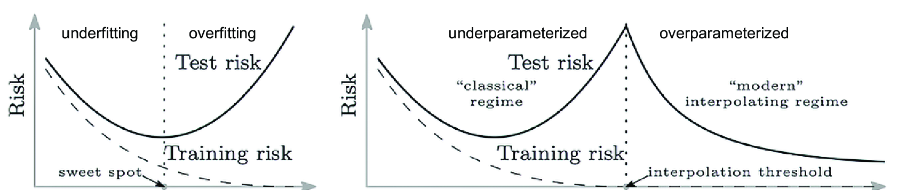
Compare the classical U-shaped test-error curve with the renewed decline beyond the interpolation threshold. section 8.5.2












