Reproducibility means obtaining consistent results when repeating an operation with the same data, code, parameters, configuration, and environment. In ML, data versioning matters alongside code versioning because changing either can change model behavior. section 1.1.1 section 1.2.1
Production-oriented reproducibility depends on:
- Versioning and tracking datasets, source code, parameters, trained models, metrics, and other artifacts. section 1.1.1 section 8.1
- Automating training so experiments execute consistently and can be repeated across development, staging, and production. section 1.1.1 section 1.2.1
- Breaking workflows into modular pipeline components that prepare data, train models, evaluate results, and integrate with infrastructure. section 8.1 section 8.0
- Treating prompts, embeddings, retrieval parameters, and LLM configurations as independently versioned parts of the system. section 12.5
Reproducible YOLO training
A production ID-card detector downloads versioned training, validation, and test images with labels, configures dataset paths and splits, then runs training and evaluation as a tracked pipeline component instead of relying on an ad hoc notebook. section 8.1
Figure 8.1 The mental map where we’re now focusing on the fourth and fifth step/component of our pipeline—model training (4) and evaluation (5)
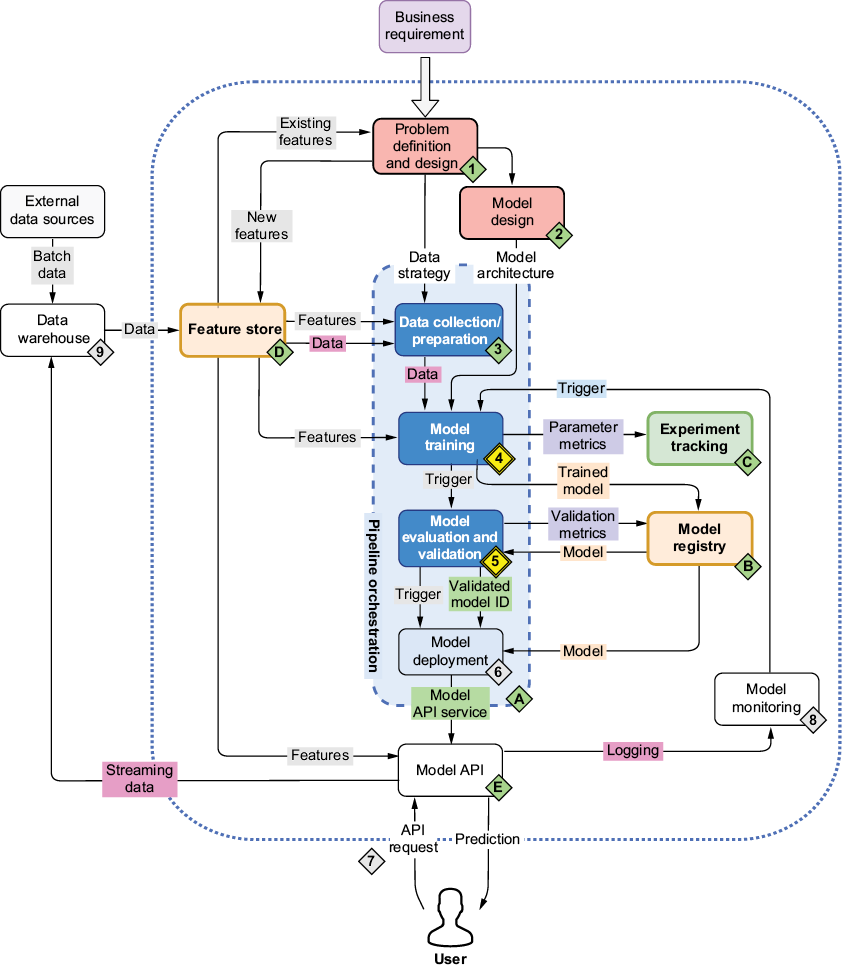
Use the ML life-cycle map to place reproducible training and evaluation within the broader production pipeline. section 8.0







