A requirement is an explicit, testable condition that a storage system or architecture must satisfy. In a lakehouse, requirements translate audited constraints and stakeholder priorities into outcome-focused criteria for design decisions. section 4.0 section 4.3.1
Begin with an audit and stakeholder discovery, then connect use cases to the lakehouse’s storage, ingestion, catalog, federation, and consumption layers. Group requirements by component, write them in plain language, and prioritize them by business value and implementation effort. section 4.1 section 4.3
Strong requirements express needs rather than prematurely selecting solutions:
- Storage: specify compliance, performance, security, integrity, cost, scalability, and operational constraints. section 4.3.1 section 5.1
- Ingestion: define throughput, latency, fault tolerance, schema management, auditability, and operational complexity. section 6.1
- Catalog: evaluate interoperability, governance, access control, operational overhead, scale, support, and cost. section 7.5
- Federation and consumption: require external connectivity, shared semantics, accessible interfaces, performance, compliance, governance, and cost alignment. section 8.2 section 9.2
Testable storage requirements
A regulated platform might require EU-collected PII to remain in EU data centers, expose S3-compatible APIs, and archive cold data after a defined period while keeping it queryable through Iceberg metadata. section 4.3.1 section 4.4.1
Figure 4.1 The journey from gathering information to establishing requirements and implementing a solution
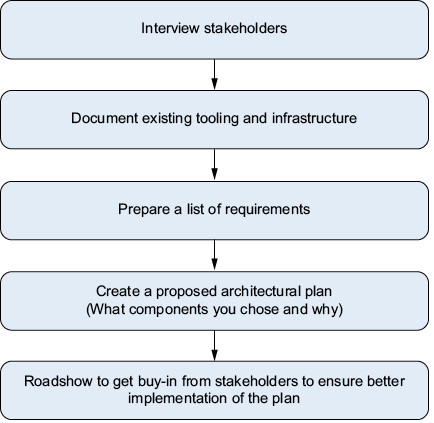
Use the audit-to-implementation journey to connect stakeholder discovery, requirements, architectural design, and implementation. section 4.1












