Requirements specify what software must do and the constraints or qualities it must satisfy. Good requirements interpret stakeholders’ goals, needs, constraints, and desired outcomes rather than merely listing features. section 4.2
Requirements change and are often misinterpreted when development begins too quickly. Generative AI can accelerate extraction, but unclear requirements only help produce a bad project faster. section 4.2
A practical AI-assisted requirements workflow:
- Define the scope and provide the design document or relevant context. section 4.2
- Request structured output, such as numbered or categorized requirements, and ask for potential pitfalls. section 4.2
- Convert the extracted requirements into user stories, then create code stubs based on those stories. section 4.2
- Review the result with stakeholders or domain experts; retain developer judgment over AI suggestions. section 4.2 section 4.7
From a design document to test-preparation requirements
For a HAM radio test-preparation application, a prompt asking for key requirements can yield a question-pool database, fields for question text and answers, data validation, random selection of 35 non-repeating questions, and an accessible user interface. Those suggestions still require review before implementation. section 4.2.1 section 4.2
Figure 9.1 A quality prompt starts with clear context, specific instructions, and an expected format. The better the input quality, the better the result.
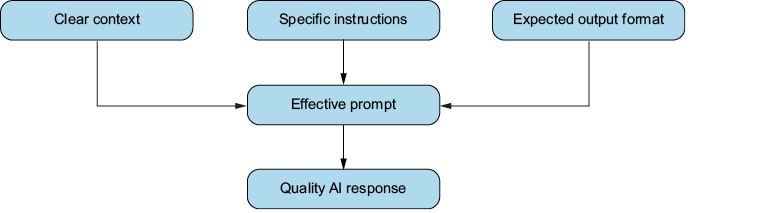
A quality prompt makes requirements actionable by combining context, specific instructions, and an expected format. section 9.1












