A reset gate is a gated recurrent unit component that controls how much prior hidden-state information is discarded when forming a new state. It helps a GRU forget information that is no longer useful while modeling sequential data. section 6.5.1
Understand the gate as part of a GRU state-update pipeline:
- Read the current input and previous hidden state. section 6.5.1
- Use the reset gate to determine how much previous information should be forgotten. section 6.4.2
- Combine the resulting information with a candidate activation to produce the actual hidden state; the update gate separately controls how much state changes. section 6.5.1
Resetting state in a graph decoder
In a neural relational inference decoder, a custom GRU processes node inputs and aggregated edge messages. Its hidden state represents node information, while reset gating determines how much prior node state is erased before predicting future frames. section 6.4.2
Figure 6.18 Design of the GRU layer, where rt represents the reset gate, zt is the update gate, ~ht is the candidate function, and ht is the final actual hidden state
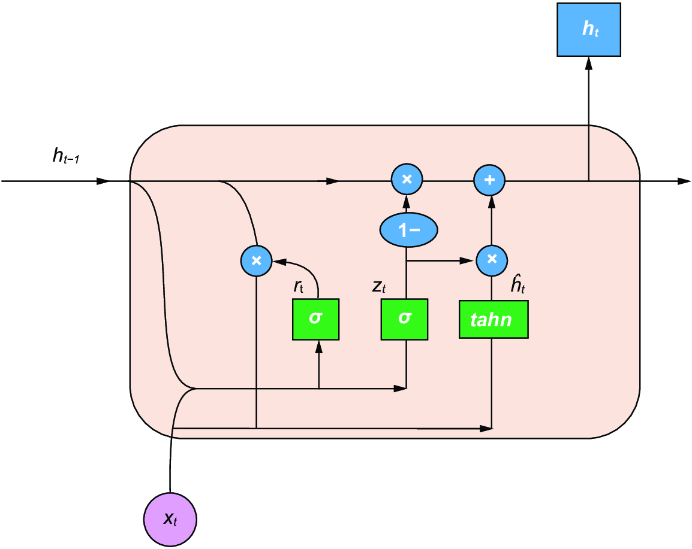
Use the GRU design diagram to distinguish the reset gate from the update gate, candidate activation, and final hidden state. section 6.5.1

