Resistance to change is a normal form of conflict that can emerge when people feel unheard or believe their views are not valued in a group decision. Rather than treating it as immaturity or a problem to suppress, treat recurring resistance as information: it may point to an overlooked perspective, an unclear decision, or a deeper hindrance to collaboration. section 8.1.3 section 8.2
In collaborative modeling, resistance can affect both participation and design quality. Groups may disagree about bounded contexts, pivotal events, proposed solutions, hierarchy, or pace. When concerns remain unspoken—especially after a high-ranking participant anchors a discussion—others may withdraw, and the resulting model can miss relevant input and perspectives. section 8.2 section 8.2
Figure 8.2 The resistance line. The further down the line the minority group goes, the less efficient the group will be able to function.
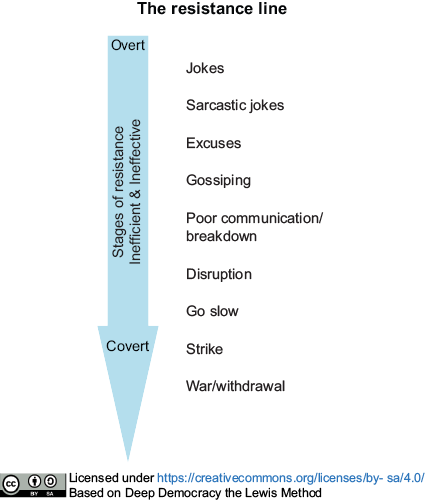
Use the resistance line to notice escalation patterns. The further resistance progresses, the harder it becomes for a group to function efficiently; look for coherent repeated behavior rather than labeling one isolated remark. section 8.1.3 section 8.1.3
Possible signals include:
- Checking out: staring out a window, turning off a remote camera, or becoming present but no longer contributing. section 8.1.3 section 8.2.1
- Sarcasm or jokes that repeatedly interrupt the conversation or pull the group off track; cultural context matters when interpreting them. section 8.1.3
- Excuses for not following an agreed decision, such as repeatedly deferring an action because something else was more important. section 8.1.3
- Interrupting, indirect communication, questions that are not really questions, or a pattern of apparent agreement followed by absence. section 8.2.1 section 8.7
From interruption to withdrawal
During a design discussion, a developer repeatedly interrupts another participant and redirects proposals toward their own ideas. Later, they nod along but stop offering options. This is not proof of motive. It is an observable edge-behavior pattern that warrants neutral attention, especially if it occurs repeatedly. A facilitator can record what happened, avoid assumptions, and help the group make the underlying concern discussable. section 8.2.1 section 8.2.1 section 8.3
Observe behavior before interpreting it. A behavior becomes a useful pattern when it can be observed objectively three times. Neutrality matters: do not assume that someone moving few sticky notes, remaining quiet, or making one sarcastic remark is resisting. Look instead for patterns, their context, and whether the session or wider organizational tensions may be involved. section 8.2.1 section 8.1.3
Resistance can create learning opportunities when it makes hidden perspectives visible. Ask what positive consequence a behavior may have for the person—for example, attention, being heard, influence, or informal rank—without reducing the person to that interpretation. Making opposing views explicit can build mutual understanding and counter functional fixedness. section 8.2.3 section 8.2.3
Facilitation aims to make collaboration and participation easier, not to force compliance. Expect resistance as part of the flow, keep a neutral rank, and assist the group in addressing what it is ready to confront. Ignored conflict can turn into resistance and edge behavior; careful observation and reflection help reveal patterns without judging them. section 8.2 section 8.3 section 8.7
Resistance after a decision often signals weak or misleading buy-in. State the decision level plainly: an idea invites influence, a suggestion has a preference, a proposal accepts serious objections, and a command communicates a decided course and responsibilities. Misframing a command as open discussion can frustrate stakeholders and intensify resistance. section 9.2.2 section 9.2.2

