Resource isolation separates workloads so one user, team, or function unit cannot consume capacity needed by another. In a shared training or hyperparameter-optimization system, isolation has two layers: execution isolation keeps training processes separate, while resource-consumption isolation sets boundaries on CPU, memory, disk, GPUs, machines, and queued work. Containerizing training code supplies process execution isolation; scheduling and cluster policy must still prevent one workload from dominating shared resources. section 3.3.7 section 5.3.1
The production problem is resource contention. If one team submits many training jobs before other teams submit theirs, a single shared queue can leave the later requests waiting until the heavy user's jobs complete. Isolation turns the cluster from an unrestricted common pool into bounded allocations for users or teams, while retaining a way to run multiple workloads on shared infrastructure. section 3.3.7
A practical isolation design assigns responsibilities at distinct layers:
- Docker containers isolate training-process execution, letting the service treat diverse training code as a black box. section 3.3.7 section 3.6
- Machine pools dedicate GPUs and machines to a team or user; separate job queues stop heavy users from blocking other pools. section 3.3.7
- Kubernetes pods provide isolated execution environments with resource guarantees, while allowing multiple pods on one node when aggregate CPU, memory, and disk requirements fit. section 1.2.5
- Kubernetes namespaces divide one physical cluster into virtual clusters and can apply resource quotas for different teams. section 1.2.5 section 3.3.7
Preventing a training queue monopoly
Three teams share a training cluster. Team A submits 100 requests, while teams B and C submit one each. With a single queue, B and C wait behind A. Assigning each team a machine pool with its own GPUs, machines, and queue creates a consumption boundary. Fixed pools can waste capacity when one pool is idle, so pools may instead have minimum and maximum sizes, with logic to move or provision servers as demand changes. section 3.3.7
Figure 3.10 Creating machine pools within the training cluster to set up the resource consumption boundary for different users.
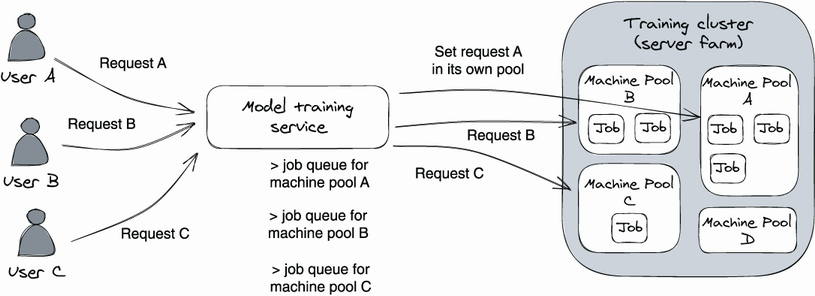
This diagram shows machine pools inside a training cluster as explicit resource-consumption boundaries for separate users. section 3.3.7
Isolation involves a utilization trade-off. Dedicated pools improve fairness but can leave idle resources stranded; shared Kubernetes infrastructure improves utilization by placing multiple bounded pods on a node. Kubernetes itself also consumes CPU and memory overhead for pods, so the isolation layer is not free. For multi-team HPO, isolation additionally avoids unconstrained shared execution and supports activity boundaries across users or groups. section 1.2.5 section 3.3.7 section 5.3.1
Choose the isolation mechanism to match the service boundary. Ray Tune can run distributed HPO and schedule trials, but it does not provide computing isolation for multiple teams: workers may face dependency-version conflicts across training codes, and it does not enforce virtual resource boundaries. Kubernetes-based infrastructure is the stronger fit when a shared service needs multitenancy, quotas, and portable deployment across cloud environments. section 5.4.3 section 5.3.1


