liveBook · Manning

Resource isolation

As explained in Kubernetes for Developers

Resource isolation restricts an application environment to specified amounts of host CPU, memory, or other system resources.

Resource isolation restricts a container to specified amounts of host CPU, memory, or other system resources. Kubernetes prevents the container from using more than its allocation, allowing multiple applications to share one host safely. section 1.1.1

Containers provide much of the isolation of virtual machines with less image size and CPU or memory overhead because they share the host kernel. This lets teams run more applications on each host and reduce infrastructure costs. section 1.1.1

Resource isolation supports practical deployment goals:

  • Run services with different dependencies on the same host. section 1.1.1
  • Pack more applications onto available infrastructure without allowing one container to consume unlimited host resources. section 1.1.1
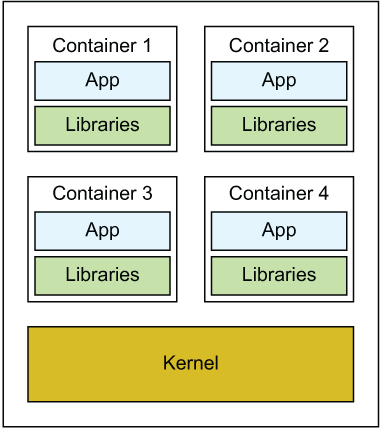
Figure 1.3 Four containers running on the same host, fully isolated but sharing the kernel
01-03

Compare multiple fully isolated containers sharing one host kernel. section 1.1.1

How Kubernetes for Developers covers it

How deep it goes
Defines resource restriction and contrasts containers with virtual machines, but stops short of configuration syntax or allocation procedures.
Examples
Uses four containers sharing a host and compares their isolation with virtual machines.
What you can do after
Operate/configure Kubernetes containers with bounded host resource usage and improved application density.
How it connects
Connects resource isolation with containers, Kubernetes, virtual machines, microservices, and shared kernels.

Also explained in

Compare how 3 books explain resource isolation →

Related concepts

This explainer was generated by Manning's knowledge graph from the text of Kubernetes for Developers. The section links point to the parts of the book it draws on.

