A resource owner is the person or entity that controls protected data or resources and can authorize an application to access them. In OAuth, the owner grants limited access without sharing credentials. section 11.2.1
Kate illustrates the role: she owns documents and workspaces, BI Explorer requests access as the client, the authorization server issues tokens, and the resource server provides data after policy evaluation. section 11.2.1
Resource ownership participates in several authorization patterns:
- Ownership rules can let owners view or edit resources while managers or teams receive separate permissions. section 9.0
- Attribute-based access control (ABAC) can compare the requester’s department with the resource owner’s department alongside clearance, time, and network conditions. section 6.2.1
- Ownership does not bypass other controls: a token identifies delegated consent, while the resource server still evaluates authorization policies. section 11.2.1
Delegated access without password sharing
Kate authorizes BI Explorer to access selected Customer Collaboration APIs. The authorization service authenticates Kate and issues scoped tokens; BI Explorer presents them to the API, which checks what access is permitted. section 11.2.1
Figure 11.4 OAuth roles in action. Kate is the resource owner, BI Explorer is the client, ACME’s Customer Authentication Service is the authorization server, and the Customer Collaboration API is the resource server.
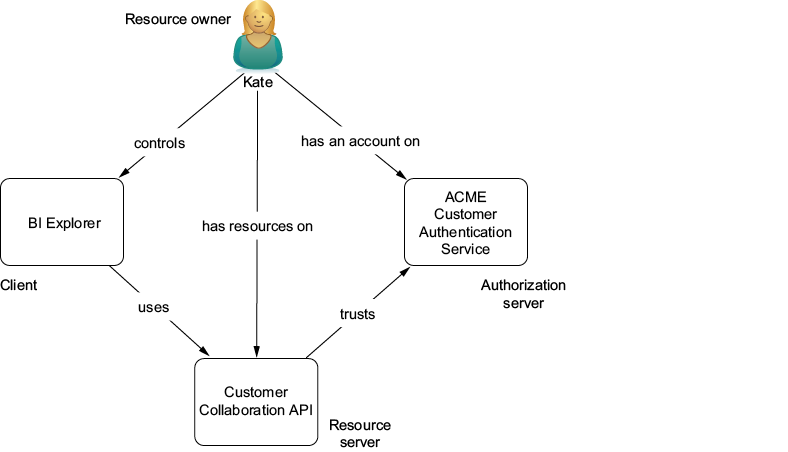
Use the role diagram to trace how the resource owner relates to the client, authorization server, and resource server. section 11.2.1

