A résumé is a concise account of your experience, skills, and accomplishments for a potential employer. Its immediate job is to help you get an interview. For a developer seeking a lead role, it should make relevant technical work and career achievements easy to find. section 2.0 section 2.2.1
Build a version suited to the position you want:
- Put your name and contact information first, followed by a career objective naming the target position. section 2.2.1
- Add a brief career summary and a technical skills summary covering relevant languages, methodologies, and tools. section 2.2.1
- Describe roughly the past five to seven years of professional experience with employers, locations, dates, tasks, and accomplishments. Condense earlier applicable roles under additional experience. section 2.2.1
- Include education and certifications, even when they do not directly match the job description. section 2.2.1
Make the match visible rather than relying on a generic list of duties. Use skills named in the job description, action verbs such as “built” or “optimized,” and numbers where they clarify results. Keep descriptions succinct. Relevant keywords can also help automated screening systems find the résumé; a longer document is not automatically a disadvantage if its information remains easy to scan. section 2.2.1 section 2.3.2
Different roles, different emphasis
A lead developer application and a developer advocate application may draw on related experience but call for different skills to be prominent. Keeping a version for each type of role is one approach; customizing for an individual opening can make the match still clearer. Open source contributions, a blog, or a GitHub portfolio can provide further evidence of work beyond paid positions. section 2.2.1 section 2.3.2 section 2.5
Figure 2.3 Example lead developer résumé
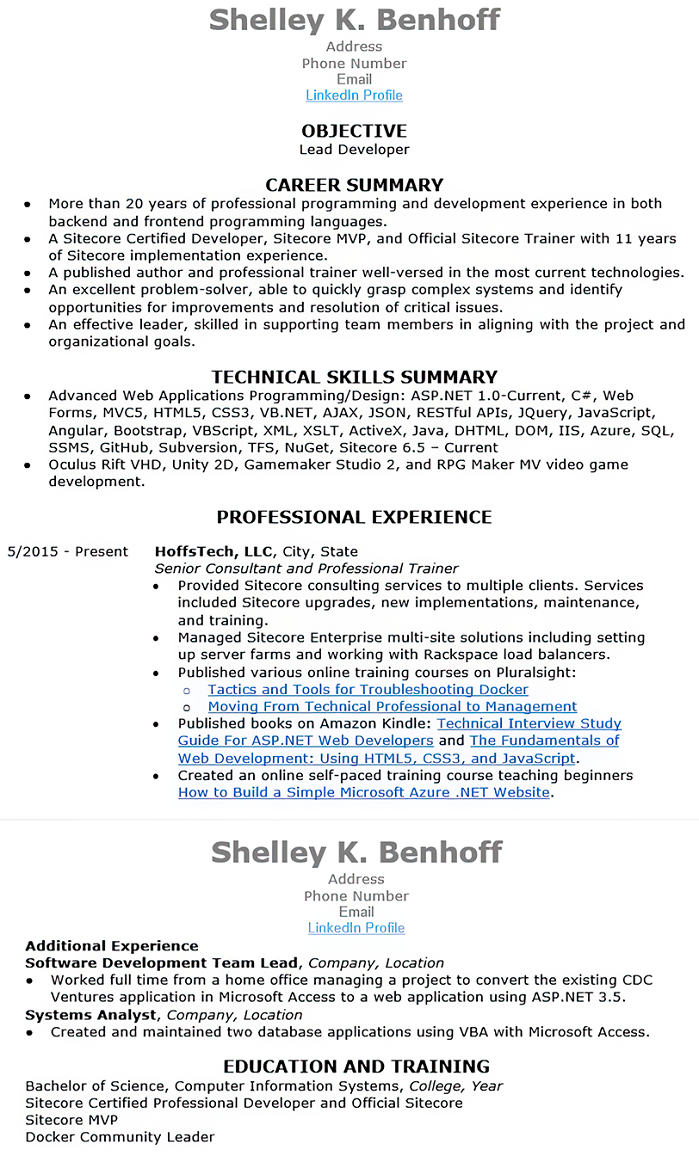
Use the example lead developer résumé as a model for arranging the recommended sections. section 2.2.1
Review the document from a hiring perspective: can someone skimming many applications quickly find relevant tools, the scale of past projects, specific problems solved, teamwork, and signs of continued learning? Clear formatting and careful proofreading help; an interview is where a reviewer can investigate the evidence more deeply. Mentors who have hired developers can also tell you what makes them read a résumé and advance a candidate. section 12.3.2 section 2.3.1

