Model retraining is the repeated training of a production model with newly available or updated data. It keeps models responsive when live data, user behavior, or business conditions change. section 1.1.2 section 2.1.7
A production retraining process connects monitoring, automation, validation, and deployment:
- Monitor system metrics, ML performance, data drift, model drift, and business outcomes to identify degradation. section 1.1.2
- Trigger retraining on a fixed schedule or when a threshold is exceeded, such as a sharp decrease in loan approvals. section 1.1.2
- Run an automated training pipeline with robust data and model validation, monitoring, lineage, and metadata. section 2.5.2
- Deploy the newly trained model automatically, while preserving replacement and rollback considerations for production reliability. section 1.1.2 section 10.1
Retraining after drift
A monitoring system detects performance deviation after new identity-card data appears in production. The pipeline collects relevant cases, retrains the detector, validates the replacement, and evaluates whether it can replace the deployed model. A recommender system can follow the same pattern with additional user data and a candidate architecture. section 2.1.7
Figure 1.2 The development/staging/production phase of the ML life cycle
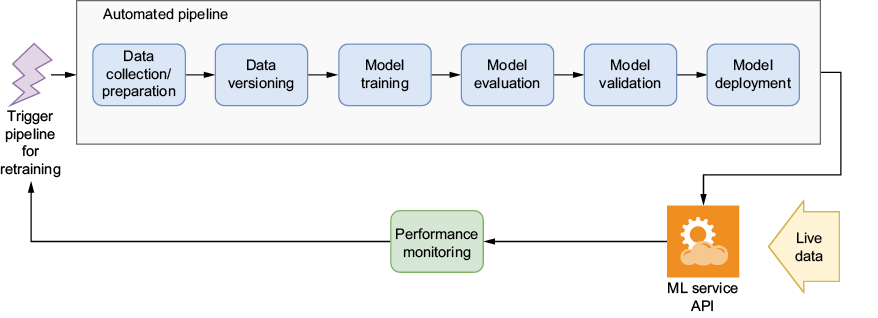
Use the ML life-cycle view to place retraining between production monitoring, model replacement, and continued operational feedback. section 1.1.2



