Socioeconomic context groups economic conditions, competition, marketing, and legal changes that influence both pricing and sales. It acts as an unobserved confounder when these factors affect the price of shoes and future sales through related paths. section 7.0
A variable belongs in this context when it affects both the treatment and outcome. Remaining stock is not itself a confounder in the basic example because it affects price but not sales directly; however, it can encode socioeconomic information and close the relevant back-door paths. section 7.0 section 7.2.1
When the context is unobserved, causal identification depends on finding observed variables that capture its influence:
- Adjust for Remaining Stock when it is the only information used to set the price. section 7.2.1
- Use weekly Purchase Orders and Shoes Sold Last Week when Remaining Stock is unavailable and both variables jointly encode it. section 7.2.1
- Do not claim a causal price effect when only one or neither substitute variable is available. section 7.2.1
Pricing shoes under changing conditions
Suppose a company raises shoe prices when it expects stock to run out. Economic conditions, competitors’ prices, marketing campaigns, and new laws may influence both that pricing decision and future sales. If inventory is recorded, adjust for Remaining Stock; otherwise, use Purchase Orders and Shoes Sold Last Week when both are available. section 7.0 section 7.2.1
Figure 7.2 Socioeconomic context is the only confounder, but it is unobserved. The remaining stock is observed and can be used to adjust for it.
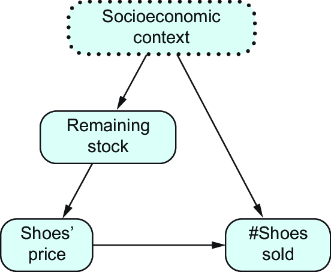
Shows socioeconomic context as an unobserved confounder and Remaining Stock as an observed variable that can support adjustment. section 7.0
Table 7.7 Different stages in searching for back-door closing variables
General pricing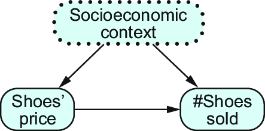
We cannot estimate the causal effect.
|
Stock is the key.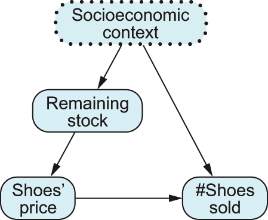
We can estimate the causal effect, adjusting for Remaining Stock.
|
Overcoming the lack of stock information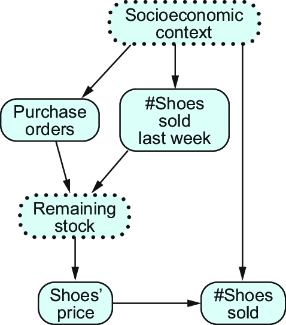
We can estimate the causal effect if we have Purchase Orders and # Shoes Sold Last Week.
|
Compares failed identification with adjustment using Remaining Stock or, when unavailable, Purchase Orders and prior sales. section 7.2.1
