A guardrail is a predefined criterion or control that maintains analytical accuracy, protects individuals, and limits biased or unreliable interpretations. In sensitive analytics, guardrails translate responsible use into explicit reporting rules. section 8.3.3
Effective guardrails can require teams to:
- Collect responses anonymously and never report individual responses. section 8.3.3
- Synthesize qualitative comments into overarching themes so writing style or specific topics cannot identify respondents. section 8.3.3
- Set a minimum aggregation level of five and suppress results for smaller subgroups. section 8.3.3
- Avoid multiple breakouts when consistently small groups could expose individuals. section 8.3.3
- Publicize the rules so participants understand how their anonymity is protected. section 8.3.3
Employee engagement reporting
An HR analytics team reports department-level satisfaction but suppresses subgroup results below five employees, excludes individual responses, and summarizes comments as themes. Communicating these safeguards helped increase survey participation from 67% to 81%. section 8.3.3
Figure 8.13 An employee engagement survey with multiple breakouts can accidentally deanonymize individuals in groups with few members. For example, the sales department has one EEOC group with n=1, making it easy to identify the person and their satisfaction.
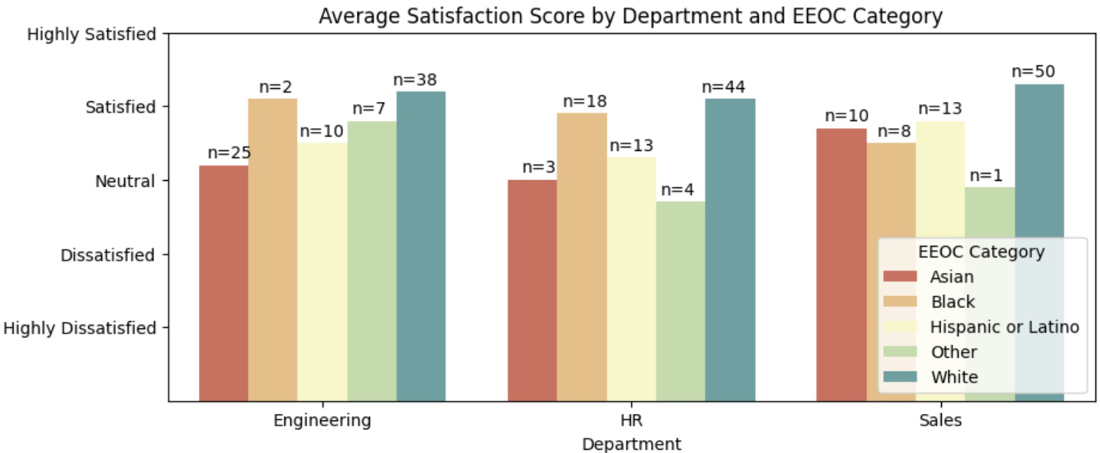
Use the figure to see how multiple demographic breakouts and a one-person subgroup can accidentally deanonymize a respondent. section 8.3.3













