liveBook · Manning

Guardrail

As explained in Effective Platform Engineering

A guardrail is a control that constrains system behavior by preventing or flagging operations outside an allowed threshold or policy.

A guardrail constrains system behavior without removing team control. In platform engineering, teams retain ownership of their pipelines while compliance and security checks verify changes at deployment. section 4.1.1

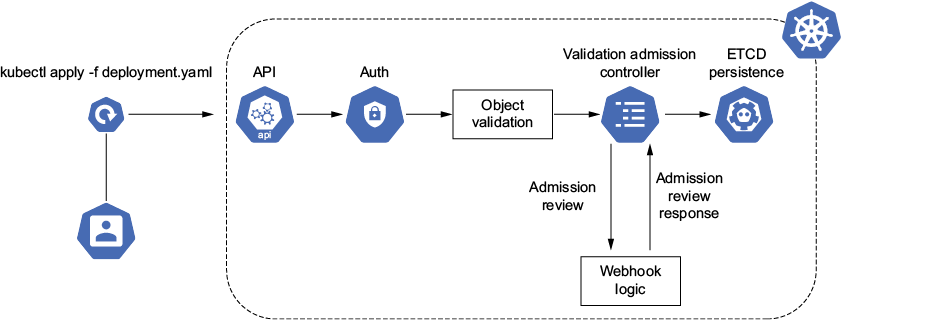
This pattern separates doing compliance work from verifying it. Kubernetes admission controllers intercept deployments and run validating webhooks before a change reaches an environment, including production. section 4.1.1

Deployment label validation

A Gatekeeper-based admission controller checks whether a deployment has the required labels before allowing it to proceed. section 4.1.1

Figure 4.3 Kubernetes admission controller
A diagram of a software controller

AI-generated content may be incorrect.

Trace how a Kubernetes admission controller intercepts deployment changes for validation. section 4.1.1


How Effective Platform Engineering covers it

How deep it goes
Explains the compliance-work and verification split and names validating webhooks, but stops short of webhook implementation details.
Examples
Uses a Kubernetes admission controller and Gatekeeper policy that checks labels on deployments.
What it assumes
Assumes familiarity with development pipelines, deployment environments, platform engineering, and compliance responsibilities.
What you can do after
Operate Kubernetes admission validation that intercepts deployments and verifies required compliance conditions.
How it connects
Connects guardrails with platform engineering, deployment, compliance verification, Kubernetes admission controllers, and access control.

Also explained in

Compare how 14 books explain guardrail →

Related concepts

This explainer was generated by Manning's knowledge graph from the text of Effective Platform Engineering. The section links point to the parts of the book it draws on.











