Selection bias, also called sampling bias, appears when the data-collection process produces measurements that do not represent the target population. The problem is especially dangerous when who gets sampled is related to what you are trying to predict. section 6.1.2
The 1948 election poll
A phone survey suggested that Dewey would win the 1948 US presidential election, prompting the Chicago Tribune’s “DEWEY DEFEATS TRUMAN” headline. Phone users were not a random sample: they were more likely to be richer, conservative, and likely to vote for Dewey. The survey therefore measured a systematically skewed slice of voters. section 6.1.2
Practical rules of thumb:
- Check whether the collection process changes who appears in the dataset or how outcomes are measured. section 6.1.2
- Treat predictions from past data cautiously when the sample or the underlying behavior may change. section 6.1.2
“DEWEY DEFEATS TRUMAN”: a famous example of sampling bias
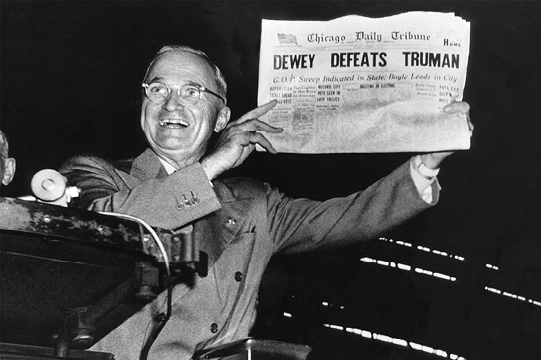
Use the historical polling example to see how an apparently ordinary collection method can produce a systematically misleading sample. section 6.1.2



