Stress testing deliberately examines a GenAI system under demanding, unusual, or adverse conditions to expose weaknesses, risk exposure, and vulnerabilities. It supports harm identification before deployment and should reflect the use case, model capabilities, and deployment scenario. section 13.3.1
Apply stress testing as part of a responsible-AI evaluation loop:
- Identify relevant harms, such as bias, privacy concerns, inaccurate information, or harmful content. section 13.3.1
- Measure how often and how severely those harms occur with clear evaluation criteria, metrics, and repeatable test sets. section 13.3
- Mitigate discovered problems with techniques such as prompt engineering or postprocessing content filters, then evaluate again. section 13.3
- Include edge cases and varied inputs, because model robustness checks can reveal unexpected or undesirable outputs. section 13.4.2
Testing harmful generation
HarmBench provides an open-source framework for automated red-teaming. It tests language models for harmful outputs such as hate speech, misinformation, toxic or biased content, and unsafe generations, helping identify where tuning or intervention is needed. section 13.4.2
Figure 13.10 RAI lifecycle
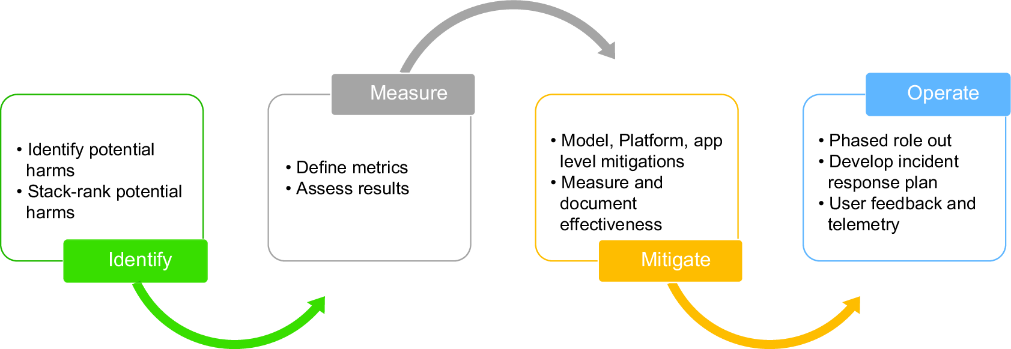
Use the RAI lifecycle diagram to place stress testing within identifying, measuring, mitigating, and operating an AI system. section 13.3



