A seed preferred share is a new stock class created for seed-round investors. It turns a relatively informal early financing into a formal, priced round, while founders, employees, and management continue to hold common shares. section 10.3
The practical differences are:
- Investors receive preferred seed shares in exchange for cash at a fixed price per share. section 10.3
- Preferred shareholders receive special rights that common shareholders do not have, especially on an exit or liquidation. section 10.4
- Raising the round dilutes existing common shareholders, but may provide the capital needed to reach a Series A. section 10.3 section 10.4
A simple seed-round calculation
Suppose a company has a $1.5 million pre-money valuation and raises $1 million, producing a $2.5 million post-money valuation. If it starts with 6 million common shares, investors receive 4 million preferred seed shares to own 40% of the resulting 10 million shares. At 25 cents per share, their preferred position also gives them priority in a low-value acquisition or liquidation; founders and employees may receive little or nothing afterward. section 10.4
Figure 10.1 Pre- and post-money valuations for a sample seed and Series A. Values are in millions, except price per share.
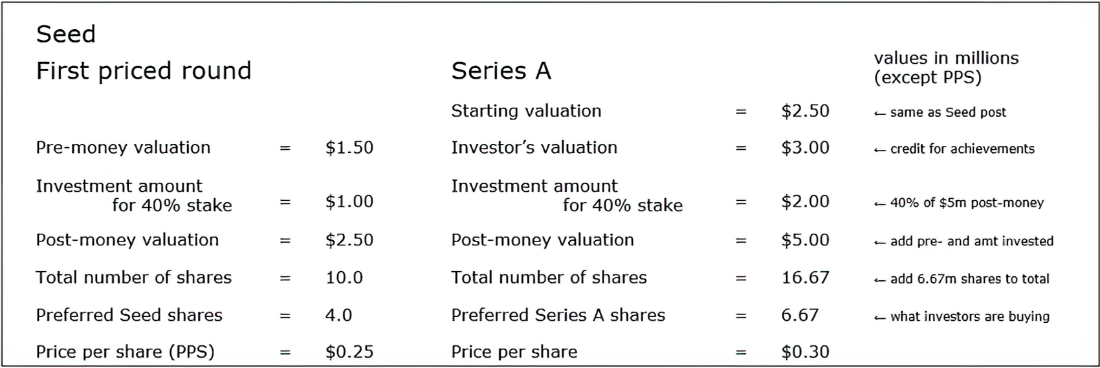
Compare the sample seed round’s valuation, share count, ownership, and price per share with the later Series A. section 10.4
