A segmentation mask is an equal-size 3D image that replaces grayscale measurements with a bit indicating whether each voxel belongs to a selected object or structure. Creating the mask from image data is called segmentation. Masks are also called voxel models. section 12.0
The representation turns a difficult-to-operate grayscale image into a practical spatial model. Filled and unfilled voxels support Boolean intersection, unification, and subtraction, as well as dilation and erosion. section 12.0 section 12.3.4
A mask can support several operations and extensions:
- Intersection keeps voxels filled in both models. section 12.3.4
- Unification keeps voxels filled in either model. section 12.3.4
- Subtraction keeps filled voxels from the first model that the second does not cover. section 12.3.4
- An extended mask can store a distance to the nearest region of interest instead of only a membership bit. section 12.0
Combining voxel models
To combine two segmented bodies, apply Boolean operations directly to their filled and unfilled voxels. This simplicity makes multistep voxel workflows comparatively robust. section 12.3.4
Figure 12.1 The same data (a) represented as an array of colors: a 2D 4×2 image made of pixels (b) and a 3D 2×2×2 image made of voxels (c)
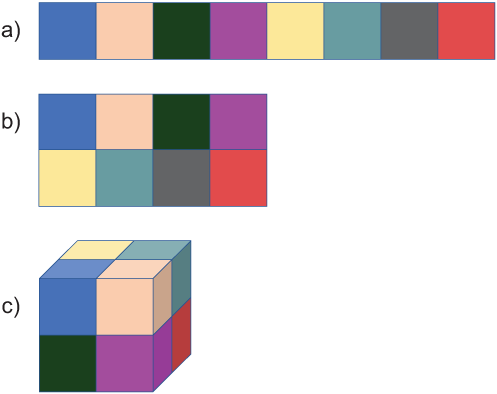
Compare pixels and voxels as arrays: a 3D image is an array of 2D images whose colored cubes represent spatial cells. section 12.0