Selection scores candidates by fitness. In the framework, a Signal performs this role, making scoring part of the existing improvement loop. section 4.1.2
In a typical evolutionary search, selection can:
- Score every candidate in a generation. section 4.3.1
- Choose the two highest-scoring candidates as parents for crossover. section 4.3.1
- Check whether the target score has been reached and end the search if it has. section 4.3.1
A toy fitness score
A toy function scores a genome as -abs(genome - TARGET), so candidates closer to TARGET score higher. In the framework equivalent, a Signal measures a mutated artifact. section 4.1.2
Figure 4.2 The same four mechanics, in two vocabularies. Evolution runs down the left column and the framework down the right: variation maps to mutate(), heredity to the parent pointer, selection to the Signal, and time to the search round. Reading across each row is how the evolutionary loop becomes the real primitives, with nothing added but new names.
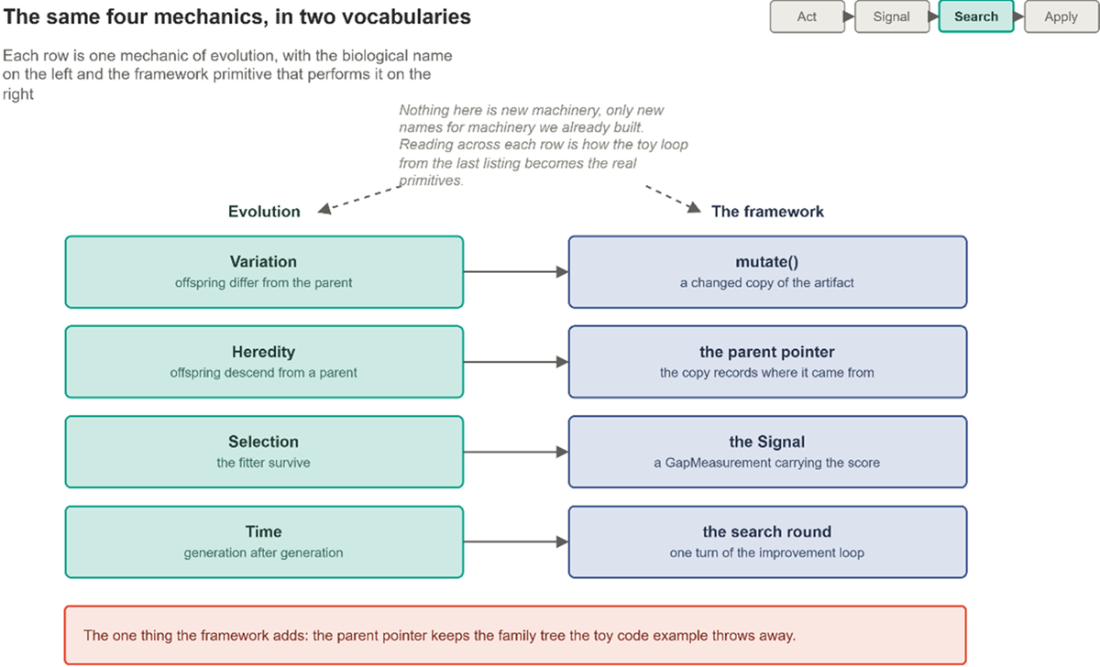
The figure maps selection to Signal scoring alongside the other mechanics of the evolutionary loop. section 4.1.2