A self-healing mechanism keeps applications available by detecting failures, restarting failed applications, and moving workloads from failed nodes to healthy ones. Kubernetes provides this behavior so developers can focus on application logic instead of implementing infrastructure recovery. section 1.2.1 section 1.2.2
Self-healing handles two common failure types:
- Software failure: automatically restart an application that crashes or runs out of memory. section 1.2.2
- Hardware failure: move applications from a failed node to remaining healthy nodes. section 1.2.1 section 1.2.2
- Operational effect: preserve service when capacity permits, while operators repair failed hardware later. section 1.2.2
A leaking application process
An application gradually consumes memory and crashes after several hours. Kubernetes restarts it automatically, allowing the service to continue. If the worker node itself fails, Kubernetes moves the application to a healthy node instead. section 1.2.2
Figure 1.8 Kubernetes is to a computer cluster what an operating system is to a computer.
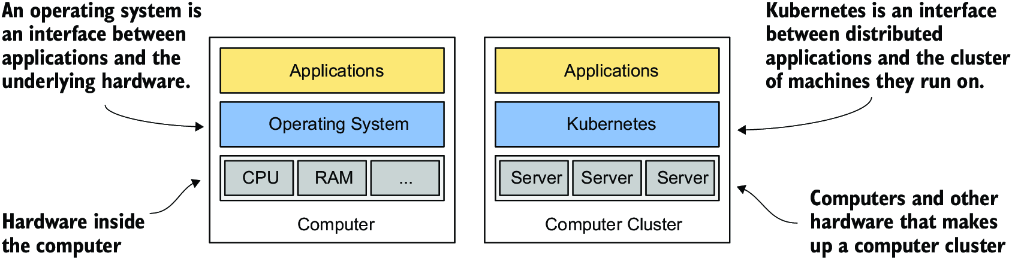
Use the operating-system analogy to place Kubernetes between applications and the underlying computer cluster. section 1.2.1


