liveBook · Manning

Semantic memory

As explained in AI Agents in Action

Semantic memory is a memory form organized around meanings, including conceptual information and associated feelings or emotions.

Semantic memory stores meanings: global or local facts, concepts, preferences, and associated feelings or emotions. In an AI agent, it provides long-term information that can be retrieved when relevant. section 8.6 section 8.6.2

A semantic memory workflow typically:

  • Captures facts, preferences, or other memory-bearing statements. section 8.6.2
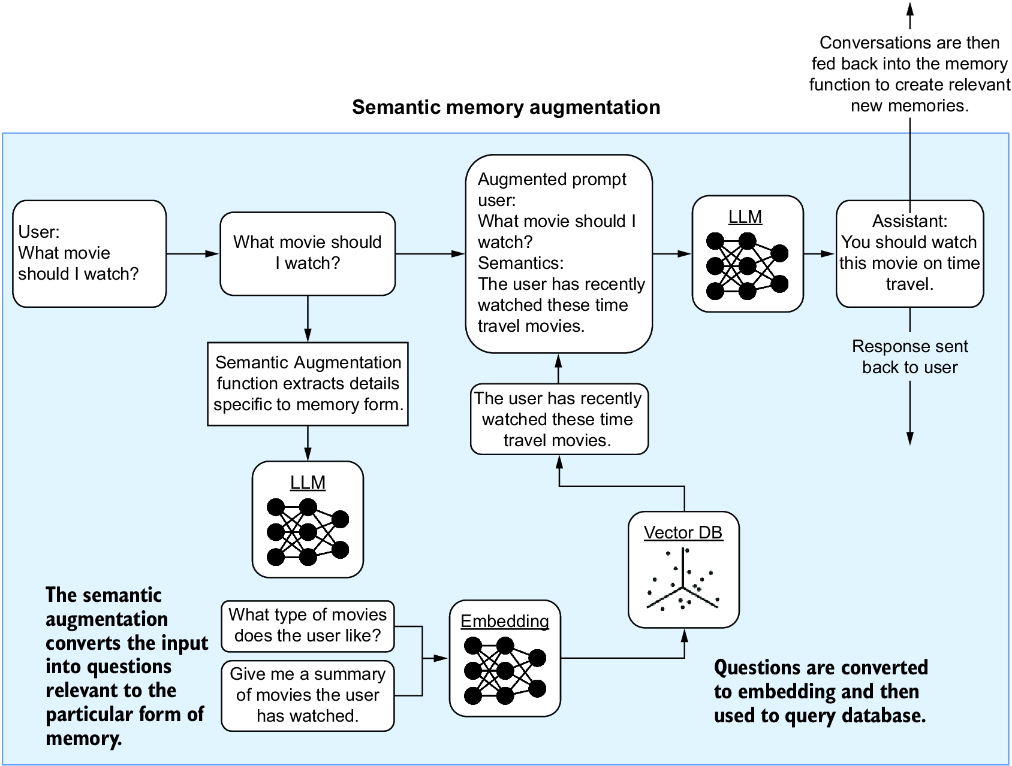
  • Processes input semantically and extracts relevant questions for retrieval. section 8.6.2
  • Retrieves relevant memories from a vector database to augment an agent prompt. section 8.6 section 8.9

One statement, two memory interpretations

The same statements can populate different memory forms. A semantic store converts them into the relevant meaning-based memory type, while episodic and procedural stores emphasize events or steps. section 8.6.2

Figure 8.17 How semantic memory augmentation works
figure

Trace how semantic augmentation transforms input into queries for more relevant memory retrieval. section 8.6.2


How AI Agents in Action covers it

How deep it goes
Explains semantic categorization, query extraction, retrieval, and configuration, but does not specify customizable memory prompts.
Examples
Uses facts and preferences, semantic memory stores, and comparisons of identical statements represented as different memory types.
What it assumes
Assumes basic awareness of agent memory and retrieval while distinguishing sensory, short-term, and long-term memory.
What you can do after
Operate/configure semantic memory stores and understand how semantic augmentation improves relevant agent recall.
How it connects
Connects semantic memory with long-term memory, episodic memory, procedural memory, retrieval-augmented generation, and vector databases.

Also explained in

Compare how 2 books explain semantic memory →

Related concepts

This explainer was generated by Manning's knowledge graph from the text of AI Agents in Action. The section links point to the parts of the book it draws on.