Separation of concerns isolates distinct application responsibilities so each part can change and be tested with minimal impact on the others. In an MVC-style application, this reduces coupling between business logic, request handling, and presentation. section 13.4.4 section 16.1
Assign each responsibility to a clearly defined component:
- The view takes data and generates HTML. section 13.4.4
- The application model executes business logic and updates application state. section 13.4.4 section 16.1
- The controller or page handler validates the request and selects the response. section 13.4.4
- Services should perform request-related business operations instead of page handlers changing data directly. section 13.5
Filtering a to-do list
A request for todo/listcategory/{category}/{username} is routed to a Razor Page handler. The handler validates the incoming values and delegates business work to a service or application model. The view then renders the returned to-do items as HTML. Changing the display does not require changing the filtering logic, while changing the business rules does not require rewriting the view. section 16.1 section 13.4.4
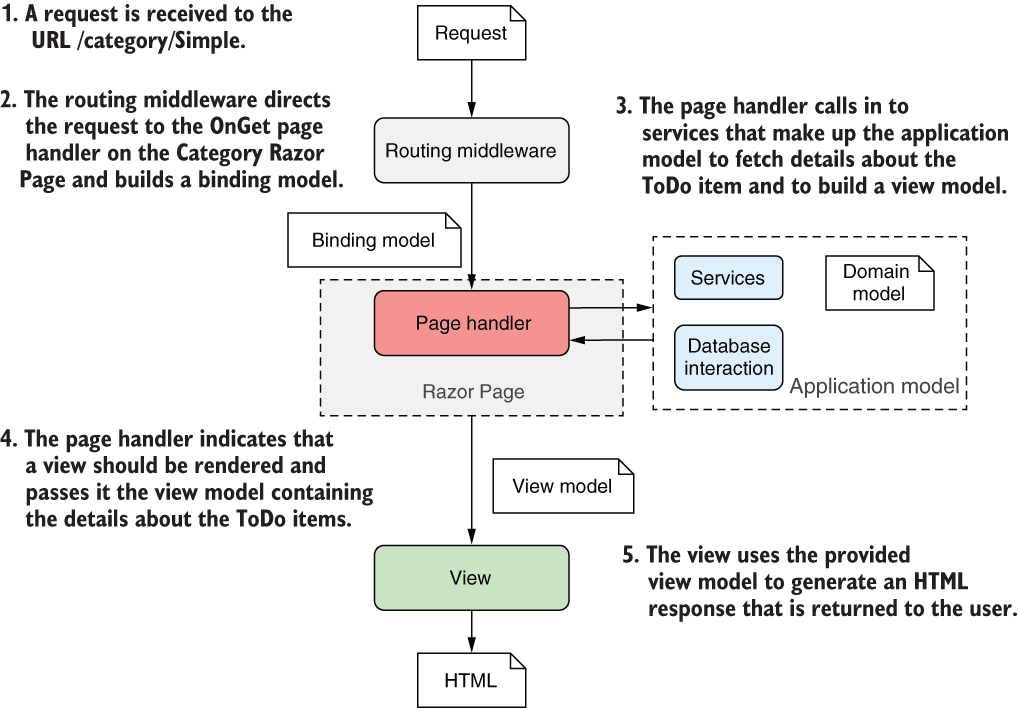
Trace how routing, the page handler, application model, and view combine to produce a complete Razor Pages response. section 13.4.4