Sequential processing runs dependent workflow steps one at a time: a later operation remains blocked until the required earlier operation completes. In a machine-learning pipeline, data ingestion must finish before model training can begin. This ordering is useful where a later step needs an earlier result, but it makes overall completion sensitive to the slowest required step. section 5.3.2 section 5.0
The cost appears when independent or partly independent work is forced into the sequence. If several model-training jobs feed model selection, one unusually long job delays selection and serving for all results. A single slow step can therefore block the rest of the workflow even when shorter jobs have already produced usable models. section 5.3 section 7.5.1
Choose the execution relationship from the dependency and delivery requirements:
- Keep steps sequential when the next step cannot start without the preceding output, such as ingestion before training. section 5.3.2
- Run synchronous steps concurrently after their shared dependencies are met when similar workloads can finish at roughly the same time. section 5.3.2
- Use asynchronous continuation when completed partial results can serve users without waiting for remaining work. section 5.3.2 section 7.5.2
Training jobs that delay model selection
Three training steps begin after ingestion, but one takes two weeks while the others take one. If model selection requires every trained model, it waits an extra week for the slowest job. Where early results are acceptable, completed short-running models can instead be sent to serving while the long-running job continues; later models add aggregated inference results. This improves responsiveness, but early simpler models may identify fewer entities than the delayed model. section 5.3 section 5.3.3 section 7.5.2
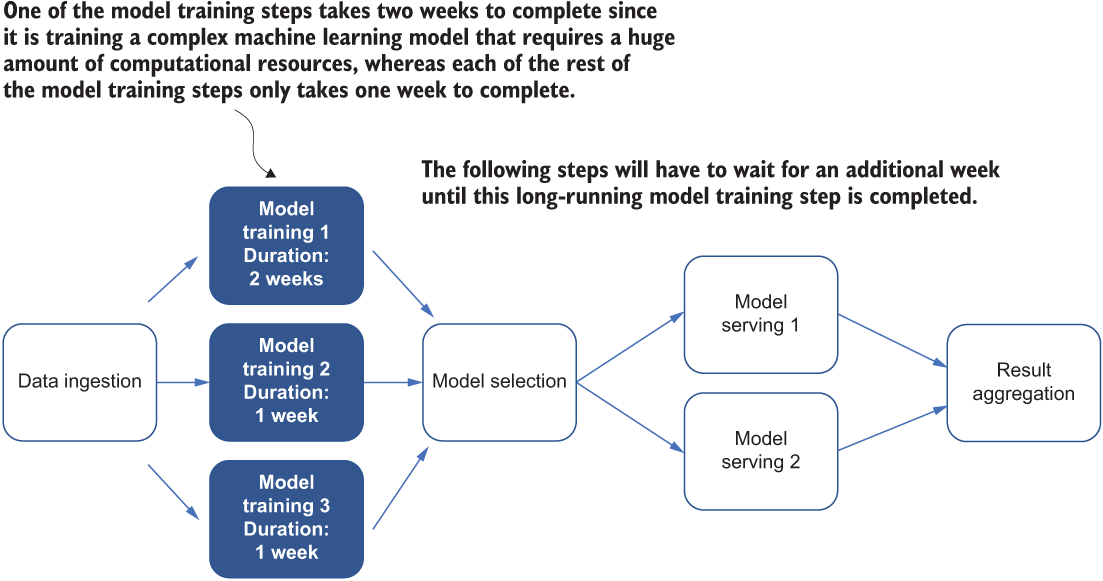
Compare the unequal training durations to see how a required slow step extends a dependent workflow’s completion time. section 5.3






