Sequential processing executes tasks one after another in a defined order, without interruption. In Python, it serves as a baseline for considering ways to reduce waits or use more CPU resources. section 3.0
A sequential solution is not always the best route to performance, but it can still be useful when designing an architecture. section 3.6
Understanding sequential, concurrent, and parallel models. Sequential execution occurs when all tasks are executed in sequence and never interrupted. Concurrent execution with no parallelism adds the possibility of a task being interrupted by another and later resumed. Parallelism occurs when several tasks are run at the same time. Even with parallelism, it is quite common for preemption to still occur as the number of processors/cores may not be enough for all tasks. A dream scenario is when there are more processors than tasks: this allows parallel execution of all tasks without the need for any preemption.
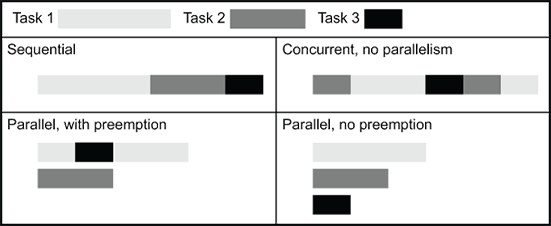
Compare sequential execution with concurrent and parallel models. section 3.0






