Service identity gives each application service an identifiable principal for authentication and authorization decisions. It lets platform rules determine which services may communicate, rather than leaving service-to-service access unrestricted. section 7.1.2
Use service identity to enforce boundaries across distributed application interactions:
- Allow Service A to call Service B while restricting other service-to-service invocations. section 7.1.2
- Specify which protocols and ports services may use for communication. section 7.1.2
- Reduce the blast radius of a compromised service by enforcing system-level interaction rules. section 7.1.2
- Control which services can connect to a message broker and read or write messages. section 7.1.4
Restricting service and broker access
A platform can identify Service A and permit it to call Service B on approved protocols and ports. The same identity rules can allow one service to publish messages while limiting another service to approved reads. section 7.1.2 section 7.1.4
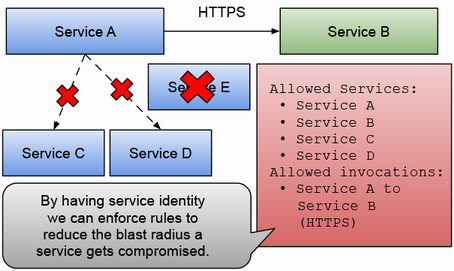
Use the diagram to trace how explicit service interaction rules reduce the blast radius of a security breach. section 7.1.2

